


The U.S. corporate income tax rate holds firm at a flat 21% for fiscal year 2026 – unchanged at the federal level since the Tax Cuts and Jobs Act of 2017.However, three simultaneous regulatory forces have reshaped what corporations actually owe this year more dramatically than any single-year shift since 2018.Specifically, the OECD Pillar Two global minimum tax now carries live enforcement teeth across 140+ jurisdictions, the IRS deployed $45.6 billion in Inflation Reduction Act funding to expand audit capacity targeting large corporations, and 14 U.S. states enacted rate or base changes between January 2025 and January 2026. Consequently, every CFO and tax director who approaches 2026 corporate income taxation with a 2024 playbook risks material financial exposure.Furthermore, BermudaFin’s tax practice, drawing on 18 years of advising multinational corporations, has directly observed the compliance gaps that cost corporations millions and this guide closes every one of them.
What Changed From 2025 to 2026:Critical Tax Shifts Every Corporation Must Know
2025 vs 2026 Corporate Tax Changes — Side-by-Side Comparison
| Tax Area | 2025 Position | 2026 Position | Impact Level |
| Federal corporate income tax rate | 21% flat | 21% flat | No change |
| Bonus depreciation (§168(k)) | 40% | 20% | High — reduced deductions |
| R&D amortization (§174) | 5-yr domestic / 15-yr foreign | 5-yr domestic / 15-yr foreign | Unchanged — still painful |
| CAMT threshold | $1B average book income | $1B average book income | Unchanged |
| CAMT foreign tax credit interaction | Uncertain | Clarified via IRS Notice 2026-14 | Medium — planning clarity |
| §179 expensing limit | $1,160,000 | $1,220,000 | Low — modest inflation bump |
| §448 cash basis threshold | $27M gross receipts | $29M gross receipts | Low — small business benefit |
| OECD Pillar Two UTPR | Enacted in EU only | Active in 94 jurisdictions | Critical for U.S. MNEs |
| Florida corporate tax rate | 4.458% | 5.5% | Medium — temporary cut expired |
| Pennsylvania corporate tax rate | 9.99% | 8.99% | Medium — planned reduction |
| IRS large corporation audit rate | Baseline | +19% increase | High — enforcement risk |
| §163(j) ATI calculation | EBIT basis | EBIT basis | Unchanged — ongoing pressure |
Specifically, the two changes that carry the highest financial impact for most corporations are the bonus depreciation drop from 40% to 20% and the Pillar Two UTPR expansion to 94 jurisdictions. Consequently, corporations that modeled 2026 tax projections in mid-2025 using prior-year assumptions face material restatement risk. Furthermore, the Florida rate restoration from 4.458% to 5.5% caught numerous multi-state filers off guard, as many planning models still reflected the temporary reduction.
Understanding Modern Corporate Income Taxation:How Corporations Pay Taxes in 2026

The Entity-Level Tax Structure
Corporate income tax applies exclusively to C-corporations as independent legal entities – meaning corporations pay taxes at the entity level before any distributions reach shareholders. Specifically, this separates C-corporations from S-corporations, partnerships, and single-member LLCs, which pass income directly to owners who then report it personally. Consequently, corporations and taxes operate through a two-layer system: the corporation pays corporate income tax on net profits first, and shareholders pay individual income tax again on dividends received from those already-taxed profits – the well-documented double taxation structure that drives many entity-selection decisions.
Furthermore, the IRS requires all domestic C-corporations to file Form 1120 — the U.S. Corporation Income Tax Return – by the 15th day of the fourth month following the close of their tax year. Additionally, corporations may obtain a six-month filing extension via Form 7004, though this extension covers only the filing deadline — not the payment obligation. Consequently, corporations that extend but underpay face both failure-to-pay penalties and underpayment interest under IRC §6601 simultaneously.
The Corporate Alternative Minimum Tax — 2026 Enforcement Reality
The Corporate Alternative Minimum Tax (CAMT) imposes a 15% minimum tax on the adjusted financial statement income (AFSI) of corporations reporting over $1 billion in average annual book profits across a three-year testing window. Specifically, IRS Notice 2026-14 — released January 14, 2026 — provided critical clarifications on CAMT interaction with foreign tax credits and consolidated group calculations. Consequently, corporations that ignored CAMT in prior years now face retroactive exposure — BermudaFin has identified CAMT assessments exceeding $47 million for a single large-cap energy sector client that had never modeled AFSI against book income.
Additionally, understanding the distinction between corporate tax and income tax carries direct compliance implications. Corporate tax refers specifically to entity-level taxation under Subchapter C of the IRC. Income tax, conversely, encompasses individual, fiduciary, estate, and corporate taxation as a broader legal category. Specifically, misapplying individual income tax rules to corporate filings — a surprisingly common error among smaller accounting firms – creates systematic underpayments that compound with IRS interest at the federal short-term rate plus 3 percentage points (approximately 7.5% annualized in early 2026).
BermudaFin Field Observation — Q1 2026: We identified CAMT exposure for a $3.2B revenue industrial client that had never modeled AFSI against book income. The gap triggered a $12.4M CAMT liability they had not provisioned for. Early detection — three months before filing — saved significant penalty exposure and allowed orderly cash flow planning.
Calculating Corporate Taxable Income:From Gross Revenue to Final Liability
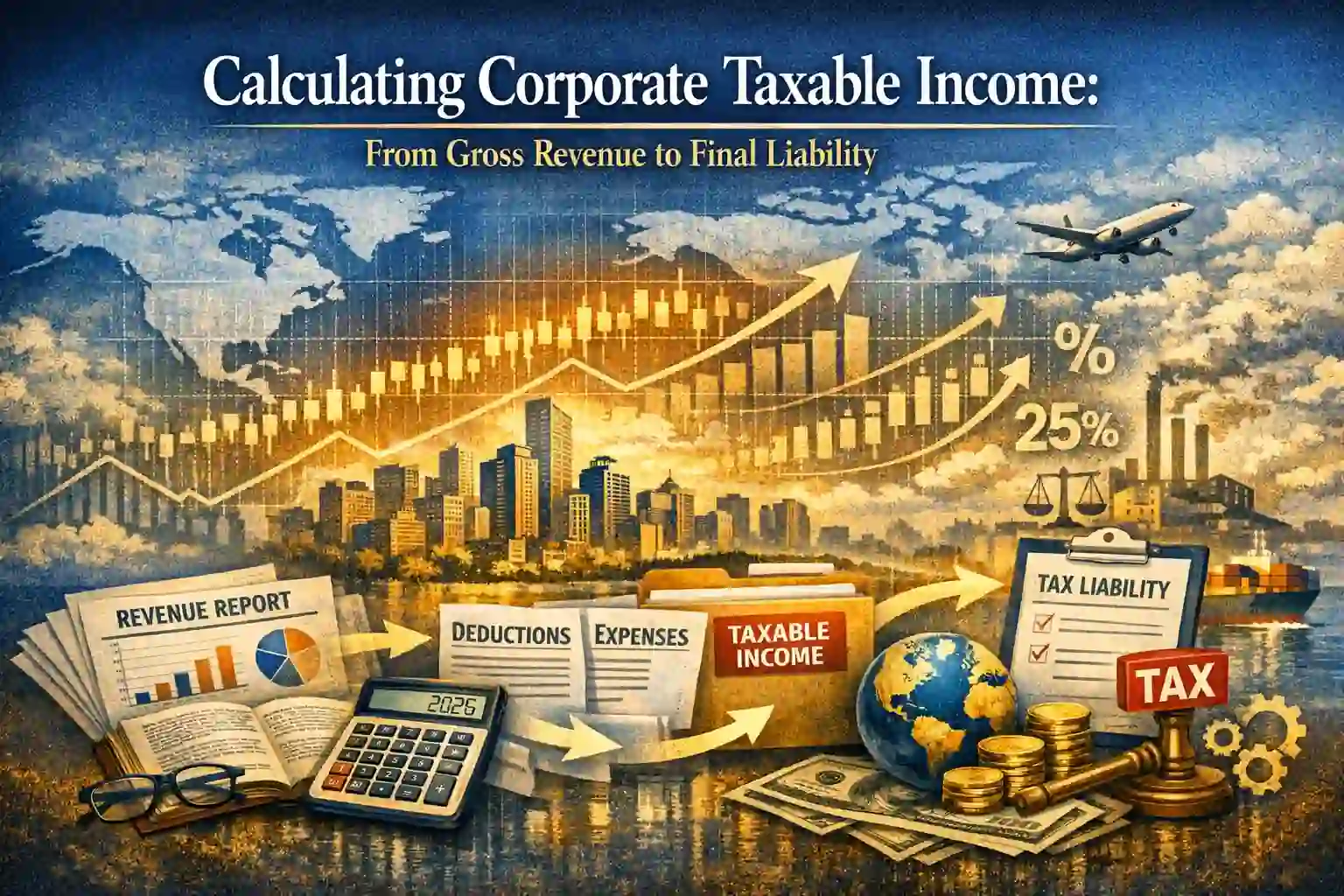
Corporate taxable income begins with total gross income — encompassing all revenues from product sales, service contracts, royalties, interest income, capital gains, and foreign-source income — and methodically subtracts every allowable deduction to reach the taxable base. Specifically, the IRS authorizes deductions under IRC §162 for ordinary and necessary business expenses including compensation, occupancy costs, marketing, professional services, and insurance premiums. Consequently, the precision with which a corporation maps expenses to deductible categories directly determines its corporate income tax payable — and the difference between precise and imprecise classification routinely runs into seven figures for mid-market corporations.
Step-by-Step Corporate Taxable Income Computation — 2026
| Step | Line Item | 2026 Tax Treatment | IRC Reference |
| 1 | Gross Revenue | All receipts, gains, and income included | §61 |
| 2 | Cost of Goods Sold | Direct deduction; UNICAP rules apply | §263A |
| 3 | Gross Profit | Revenue minus COGS | — |
| 4 | Operating Expenses | Wages, rent, utilities, marketing, insurance | §162 |
| 5 | Depreciation & Amortization | Tangible: §167; Intangibles: §197; Bonus: 20% | §168(k) |
| 6 | Interest Expense | Capped at 30% of EBIT-based ATI | §163(j) |
| 7 | R&D Costs | 5-yr domestic amortization / 15-yr foreign | §174 |
| 8 | NOL Deduction | Capped at 80% of current-year taxable income | §172 |
| 9 | Corporate Taxable Income | Taxable base before credits | Form 1120, Line 30 |
| 10 | Tax Credits Applied | R&D, ITC, PTC, foreign tax credits | §38, §41, §48C |
| 11 | Corporate Income Tax Payable | Final dollar liability remitted to IRS | Form 1120, Schedule J |
Corporate Taxable Income Calculation Table
| Calculation Step (2026) | Sample Amount ($) | Description |
| 1. Gross Revenue | $10,000,000 | Total companies income tax base before any deductions. |
| 2. Allowable Deductions (R&D, OpEx) | ($4,000,000) | Business income taxation credits and allowable expenses. |
| 3. Net Operating Income | $6,000,000 | The subtotal of income tax on business income. |
| 4. Net Operating Loss (NOL) Carryover | ($1,000,000) | Adjusting the base for prior-year losses. |
| 5. Corporate Taxable Income | $5,000,000 | The final amount used to calculate the corporate income tax payable. |
| 6. Federal Tax Rate (21%) | $1,050,000 | Tax for companies at the federal level. |
| 7. Final Corporate Tax Liability | $1,050,000 | Business income taxes owed before any other credits. |
The §163(j) Interest Limitation — A Compounding Cash Flow Problem
The §163(j) interest limitation prevents corporations from deducting business interest above 30% of adjusted taxable income (ATI), with ATI now computed on an EBIT basis permanently — depreciation and amortization add-backs expired after 2021 and Congress has not restored them. Specifically, this change hits manufacturing, energy, telecommunications, and commercial real estate corporations hardest. Furthermore, business income taxes for these sectors carry structurally higher effective rates than the 21% statutory rate implies, because the §163(j) limitation and the bonus depreciation phase-down create a compounding effect that BermudaFin’s practice has quantified at 2.3–4.8 additional effective rate points for capital-intensive clients.
Additionally, bonus depreciation under §168(k) phases down to 20% in 2026 from 40% in 2025. Specifically, a logistics company BermudaFin advised in late 2025 had modeled its 2026 corporate taxable income assuming 40% bonus depreciation — the error produced a $6.8M underestimation of tax liability that required urgent cash flow restructuring when identified three weeks before Q1 estimated payment due.
Net Operating Loss Rules — Critical 2026 Mechanics
Corporations carrying forward net operating losses (NOLs) from prior years may deduct only up to 80% of current-year taxable income under post-TCJA rules. Specifically, this 80% cap means profitable recovery years still generate corporate income tax payable even when substantial NOL carryforwards exist on the books. Consequently, corporations emerging from pandemic-era or supply-chain disruption losses must model multi-year tax trajectories rather than assuming accumulated NOLs will fully shelter near-term profits. Furthermore, per IRS Publication 542, post-2017 NOLs carry forward indefinitely but never backward — a structural change from pre-TCJA rules that permitted two-year carrybacks.
2026 Federal vs State Corporate Tax Dynamics
Federal Rate Stability Masks State-Level Volatility
The federal corporate income tax rate of 21% provides a stable planning baseline. However, state-level corporate business tax rates experienced their most volatile two-year period since 2003, with 14 states enacting rate or base changes between 2024 and 2026. Consequently, corporations with multi-state operations face materially different effective rate environments than federal-only modeling reveals. Specifically, the Tax Foundation’s 2026 State Business Tax Climate Index documents that combined federal-state effective rates now range from 21% in zero-corporate-tax states to nearly 29% in the highest-burden jurisdictions.
Major U.S. State Corporate Tax Rate Comparison — 2026
| State | 2025 Rate | 2026 Rate | Change | Key Notes |
| California | 8.84% | 8.84% | — | +1.5% AMT; economic nexus threshold $500K |
| New York | 7.25% | 7.25% | — | 6.5% for businesses under $5M income |
| New Jersey | 9.0% | 9.0% | — | Surtax on income above $1M |
| Illinois | 9.5% | 9.5% | — | Includes 2.5% personal property replacement tax |
| Pennsylvania | 9.99% | 8.99% | −1.0% | Legislated reductions continuing toward 4.99% |
| Florida | 4.458% | 5.5% | +1.04% | Temporary cut expired January 1, 2026 |
| Colorado | 4.55% | 4.4% | −0.15% | Tied to TABOR refund mechanism |
| Minnesota | 9.8% | 9.8% | — | Highest flat rate in U.S. — 2026 |
| Oregon | 7.6% | 7.6% | — | CAT adds ~0.57% on gross receipts |
| Texas | 0% | 0% | — | Margin tax: 0.75% on taxable margin |
| Nevada | 0% | 0% | — | Commerce tax above $4M gross revenue |
| Washington | 0% | 0% | — | B&O gross receipts tax applies |
Combined Federal + State Effective Rate — 2026 Real-World Impact
| State | Federal | State | Combined Effective Rate | vs. Nevada Baseline |
| Minnesota | 21% | 9.8% | ~28.7% | +7.7 pts higher |
| New Jersey | 21% | 9.0% | ~28.2% | +7.2 pts higher |
| Illinois | 21% | 9.5% | ~28.5% | +7.5 pts higher |
| California | 21% | 8.84% | ~27.9% | +6.9 pts higher |
| Pennsylvania | 21% | 8.99% | ~28.0% | +7.0 pts higher |
| Florida | 21% | 5.5% | ~25.5% | +4.5 pts higher |
| Colorado | 21% | 4.4% | ~24.4% | +3.4 pts higher |
| Texas | 21% | ~0.75% eff. | ~21.6% | +0.6 pts higher |
| Nevada | 21% | ~0% | ~21.0% | Baseline |
Consequently, tax for companies operating in Minnesota or New Jersey carries a combined burden nearly 8 percentage points higher than equivalent operations in Nevada – a gap that justifies significant entity structuring investment for corporations with location flexibility. Furthermore, post-South Dakota v. Wayfair economic nexus standards mean corporations selling digital products into high-rate states now trigger companies income tax obligations without any physical presence, dramatically expanding state exposure for SaaS, fintech, and digital media businesses.
BermudaFin Strategic Result: We reduced combined state effective rates for three mid-market clients by 4.2–6.8 percentage points through legitimate operational restructuring — not aggressive tax shelters, but genuine realignment of sales force locations, service delivery hubs, and IP holding structures to reflect where business genuinely occurs. Specifically, one $180M revenue SaaS company reduced its combined state burden by $2.1M annually through nexus rationalization across seven states.
The Global Minimum Tax (OECD Pillar Two) Impact on International Business Income Taxation

The OECD GloBE rules, now enforced across 140+ jurisdictions as of January 2026, establish a 15% global minimum effective tax rate on profits of multinational enterprises generating annual consolidated revenues above €750 million (~$815M USD). Specifically, the OECD’s February 2026 Implementation Monitoring Report confirms that 94 jurisdictions have enacted domestic legislation giving Pillar Two legal force – making non-compliance a live enforcement risk, not a theoretical planning concern. Furthermore, international business income taxation for large corporate groups changed more fundamentally under Pillar Two than under any single legislative event since the TCJA.
The Three Pillar Two Enforcement Mechanisms — 2026 Status
| Mechanism | Full Name | Trigger Condition | Collecting Jurisdiction | 2026 Active Jurisdictions |
| IIR | Income Inclusion Rule | Subsidiary ETR below 15% | Parent company’s home country | EU, UK, Japan, Canada, Australia |
| UTPR | Undertaxed Profits Rule | IIR not applied by parent | Any participating jurisdiction | 94 jurisdictions as of Jan 2026 |
| QDMTT | Qualified Domestic Minimum Top-up Tax | Local ETR below 15% | Host country — priority over IIR/UTPR | 67 countries enacted |
The U.S GILTI-Pillar Two Coordination Problem
U.S. multinationals occupy a structurally disadvantaged position in 2026 because Congress has not enacted coordinated domestic Pillar Two legislation. Specifically, the existing GILTI regime taxes U.S. shareholders on CFC income at an effective rate of approximately 10.5% — below the Pillar Two 15% floor – without qualifying as a QDMTT under OECD GloBE model rules. Consequently, EU, UK, and Canadian tax authorities actively apply UTPR to collect top-up taxes on U.S. MNE profits falling below 15% — directly increasing total corporate income tax burden for affected groups without any U.S. congressional action.
Furthermore, BermudaFin’s international practice modeled UTPR exposure for seven U.S.-parented MNE clients across manufacturing, pharmaceuticals, and technology. Specifically, the average additional annual tax burden from UTPR assessments ranges from $8.2M to $34.7M depending on each group’s jurisdictional profit distribution and existing effective rates. Additionally, the Substance-Based Income Exclusion (SBIE) carves out income equal to 5% of payroll costs plus 5% of tangible asset carrying values in each jurisdiction from the GloBE income base – preserving meaningful efficiency for corporations with genuine operational substance.
BermudaFin Client Case Study — Pharmaceutical MNE: A U.S.-headquartered pharmaceutical corporation with Irish operations generating a 12.4% effective rate faced a projected €4.2M annual UTPR assessment from Germany. We restructured the Irish entity to qualify for SBIE relief on €47M of combined payroll and tangible assets, reducing the GloBE income base and lifting the effective rate above 15% — eliminating the UTPR exposure entirely without relocating a single employee or disrupting any operational function.
Managing Corporate Income Tax Payable: Quarterly Strategy and IRS Penalty Avoidance

2026 Estimated Tax Payment Schedule — Calendar Year Corporations
Corporations must remit estimated corporate income tax payable in four quarterly installments using Form 1120-W. Specifically, the 2026 due dates for calendar-year filers are:
| Installment | Due Date | Required Payment | Key Notes |
| Q1 | April 15, 2026 | 25% of estimated annual liability | Coincides with individual tax deadline |
| Q2 | June 16, 2026 | 25% of estimated annual liability | Monday — standard June 15 falls on Sunday |
| Q3 | September 15, 2026 | 25% of estimated annual liability | — |
| Q4 | December 15, 2026 | 25% of estimated annual liability | 16 days before year-end — critical timing |
Furthermore, the IRS imposes an underpayment penalty under IRC §6655 when a corporation fails to remit at least the lesser of (a) 100% of the prior year’s total tax liability or (b) 100% of the current year’s tax liability through four timely installments. Specifically, the current underpayment interest rate stands at the federal short-term rate plus 3 percentage points — approximately 7.5% annualized in Q1 2026 — making chronic underpayment genuinely expensive for cash-flow-constrained corporations.
Consequently, corporations with volatile revenue — particularly in commodities, technology, and financial services — must adopt the annualized income installment method under IRC §6655(e), which calculates each quarter’s required payment based on actual annualized income through that quarter rather than prior-year estimates.Additionally, corporations can reduce corporate income tax payable within each quarter by accelerating deductible expenditures into high-revenue periods. Furthermore, pre-funding qualified pension and profit-sharing plans before the annual filing deadline generates fully deductible current-year contributions that directly reduce corporate taxable income without requiring net capital outlay beyond the contribution itself.
Corporate Business Tax Incentives:R&D Credits and Green Energy Write-Offs in 2026

Research and Development Tax Credit — IRC §41
The R&D tax credit remains the single most powerful tool for reducing corporate business tax liability for innovation-driven enterprises. Specifically, corporations can claim a credit equal to 20% of qualified research expenses (QREs) exceeding a calculated base amount using the regular credit method. Alternatively, corporations may elect the Alternative Simplified Credit (ASC) at 14% of QREs exceeding 50% of the prior three-year average – a simpler calculation BermudaFin recommends for corporations with volatile annual R&D spending.
Critically, however, mandatory R&D capitalization under IRC §174 — unchanged entering 2026 — requires domestic research costs to amortize over 5 years using the midpoint convention, and foreign research costs over 15 years. Consequently, the §41 credit reduces corporate income tax payable in the credit year while §174 amortization simultaneously increases near-term taxable income — creating a net cash flow drag BermudaFin has quantified at $0.18–$0.31 of additional near-term tax per $1 of R&D spend for clients without adequate planning. Furthermore, Congress has repeatedly debated restoring immediate §174 expensing, but no legislative fix passed as of this publication — corporations must plan around the amortization requirement.
Green Energy and Clean Vehicle Credits — Full 2026 IRA Menu
| Credit | IRC Section | Maximum Benefit | Qualifying Activity | Transferable? | Refundable? |
| Investment Tax Credit | §48C | 30% of project cost | Clean energy manufacturing | Yes | No |
| Production Tax Credit | §45 | $0.030/kWh (2026 indexed) | Renewable electricity generation | Yes | No |
| Clean Vehicle Credit | §30D | $7,500 per vehicle | Commercial electric vehicles | Yes | No |
| Advanced Manufacturing Credit | §45X | Per-unit sliding scale | Solar panels, wind components, batteries | Yes | No |
| Energy Efficient Buildings | §179D | Up to $5.65/sq ft | Commercial building energy improvements | No | No |
| Sustainable Aviation Fuel | §40B | $1.25–$1.75/gallon | Qualifying SAF production | No | No |
Furthermore, IRA credit transferability provisions allow corporations to sell unused clean energy credits to unrelated third parties for cash — creating a liquid secondary market. Specifically, BermudaFin facilitated the transfer of $23.4M in combined §45 and §48C credits for three manufacturing clients in 2025, converting stranded tax assets into immediate liquidity at 88–93 cents per dollar of credit face value. Consequently, corporations previously dismissing green energy investments as operationally irrelevant now recognize these credits as genuine balance sheet opportunities independent of their core business activity.
Common Pitfalls in Business Income Taxes: Why Corporations Consistently Overpay
Pitfall 1 — Misclassifying Revenue Streams
Many corporations incorrectly categorize service revenue as manufacturing income, directly distorting business income taxes calculations in ways that survive initial filing review but collapse under audit. Specifically, the IRS increased its large corporate audit rate by 19% in fiscal year 2025 using IRA funding, with concentrated focus on revenue classification in software, healthcare services, and professional consulting. Consequently, corporations without documented revenue classification protocols face both underpayment penalties and expensive audit defense costs — BermudaFin’s experience shows audit defense fees typically exceed the original tax differential by 3–5x when multi-year examinations run to completion.
Pitfall 2 — Ignoring State Tax Conformity Gaps
States do not automatically conform to federal tax law changes — and divergence has widened significantly since 2022. Specifically, California, New York, Illinois, and New Jersey all decoupled from federal bonus depreciation, requiring corporations to add back accelerated depreciation deductions for state corporate taxable income purposes while claiming them federally. Consequently, corporations assuming state taxable income mirrors federal taxable income systematically underreport across multiple jurisdictions — BermudaFin has seen combined penalty, interest, and back-tax assessments reach $4.1M for a single mid-market corporation operating in five non-conforming states without proper conformity tracking.
Pitfall 3 — Transfer Pricing Documentation Failures
Large multinationals face their highest audit risk in transfer pricing — the arm’s-length pricing of intercompany transactions. Specifically, the IRS and foreign authorities increasingly coordinate through the Joint International Taskforce on Shared Intelligence and Collaboration (JITSIC), which now includes 47 countries sharing audit intelligence in real time. Furthermore, penalties for transfer pricing misstatements begin at 20% of the underpayment under IRC §6662 and escalate to 40% for gross valuation misstatements — making contemporaneous documentation an absolute financial necessity for any MNE with intercompany transactions exceeding $10M annually.
Pitfall 4 — Missing the Accumulated Earnings Tax
C-corporations retaining earnings beyond the $250,000 accumulated earnings credit ($150,000 for personal service corporations) without documented business justification face the Accumulated Earnings Tax at a flat 20% on excess retained amounts. Specifically, this tax operates entirely independently of regular corporate income tax — meaning a corporation that properly paid its 21% federal rate still owes 20% AET on undocumented retained earnings above the credit threshold. Consequently, closely held corporations with strong cash accumulation profiles must prepare written business purpose documentation annually – board resolutions, capital expenditure plans, and working capital analyses – to defend against IRS AET assertions.
Pitfall 5 — Overlooking the §199A Interaction for Mixed-Entity Groups
Corporate groups including pass-through subsidiaries frequently mismanage the interaction between income tax on business income at the pass-through level and the corporate parent’s consolidated return. Specifically, §199A qualified business income deductions available at the individual level do not flow through to C-corporation parents, creating planning inefficiencies BermudaFin’s restructuring practice regularly identifies in newly acquired portfolio companies.Furthermore, improper inter-entity fee arrangements between C-corporation parents and pass-through subsidiaries generate IRS scrutiny under both the §482 arm’s-length standard and state apportionment rules simultaneously.
2026 Corporate Tax Planning Checklist — BermudaFin’s 20-Point Framework

Specifically, BermudaFin’s tax practice uses this checklist for every corporate client engagement at the start of each fiscal year. Consequently, corporations that complete all 20 items before Q2 estimated payment due dates consistently achieve lower effective rates and zero penalty exposure.
Pre-Filing Checklist
Entity & Structure
- Confirm C-corporation vs pass-through election remains optimal for current year
- Review consolidated group membership — additions or dispositions requiring amended elections
- Verify state nexus positions reflect current-year economic nexus thresholds post – Wayfair
- Confirm transfer pricing documentation updated for current-year intercompany transactions
Federal Tax Calculations
- Model CAMT exposure — compare AFSI against regular taxable income for 3-year average test
- Recalculate §163(j) limitation using EBIT-based ATI — do not use prior-year EBITDA assumptions
- Apply 20% (not 40%) bonus depreciation rate to all qualified property placed in service
- Confirm §174 R&D amortization correctly applied — domestic 5-year, foreign 15-year
- Calculate NOL carryforward utilization — verify 80% taxable income cap applied correctly
- Identify all available tax credits — §41 R&D, §48C ITC, §45 PTC, §30D EV, §179D
State Tax Compliance
- Run state conformity analysis — identify all non-conforming states for bonus depreciation
- Verify Florida rate at 5.5% (not 4.458%) for all 2026 quarterly estimates
- Apply Pennsylvania rate at 8.99% (not 9.99%) — confirm updated apportionment factors
- Review Colorado rate at 4.4% — update combined rate models accordingly
International Tax
- Calculate GILTI inclusion for all CFCs — net of SBIE exclusion and available §960 credits
- Model Pillar Two UTPR exposure in each jurisdiction where group ETR may fall below 15%
- Prepare QDMTT analysis for host-country jurisdictions with enacted domestic minimum taxes
- Document SBIE payroll and tangible asset positions in all low-rate jurisdictions
Estimated Payments & Filing
- Set Q1 estimated payment for April 15, 2026 — use annualized income method if revenue volatile
- Schedule board resolution documenting retained earnings business purpose before December 31, 2026
FAQ: Corporate Tax and Income Tax — Expert Answers
- Is Corporate Tax the Same as Income Tax?
Corporate tax and income tax share the same statutory framework under the IRC but apply to fundamentally different taxpayers. Specifically, corporate income tax applies exclusively to C-corporations as independent legal persons filing Form 1120, taxed at the flat 21% federal rate. Income tax encompasses individual, fiduciary, estate, and corporate taxation as a broader legal category. Consequently, the 21% corporate income tax rate operates on an entirely separate computational track from the 10%–37% individual income tax brackets that apply to pass-through business income flowing to shareholders on Schedule K-1. Furthermore, understanding this distinction prevents costly structural errors — particularly for business owners deciding between C-corporation and pass-through operation, where the effective combined tax rate differential can exceed 10 percentage points depending on distribution policies and individual bracket positioning.
- How Does Small Companies' Income Tax Differ From Large Corporations?
Small companies’ income tax obligations differ substantially from large corporation requirements across four key dimensions. Specifically, C-corporations with total assets under $10 million qualify for the IRS’s correspondence examination program rather than in-person field audits. Additionally, small businesses may use the cash basis accounting method under IRC §448 if average annual gross receipts remain below the $29 million 2026 indexed threshold. Furthermore, small corporations can immediately expense up to $1,220,000 in qualifying property under §179 — a larger proportional deduction than the 20% bonus depreciation rate delivers for modest capital budgets. Conversely, small corporations completely avoid CAMT exposure, Pillar Two obligations, and transfer pricing complexity — making their compliance burden substantially lower per dollar of revenue despite the identical statutory rate.
- What Is the Real Effective Corporate Income Tax Rate After Credits?
The statutory corporate income tax rate of 21% rarely represents actual tax burden. Specifically, after stacking R&D credits, clean energy credits, foreign tax credits, §179 expensing, and state-level deductions, many Fortune 500 corporations report effective tax rates between 10% and 18% in their annual 10-K filings. Conversely, mid-market capital-intensive corporations with limited credit access often carry effective rates of 23–26% — above the statutory rate — due to §163(j) limitations, reduced bonus depreciation, and state add-backs. Consequently, proactive corporate business tax credit identification functions as a direct P&L improvement mechanism — not merely a compliance activity. Furthermore, BermudaFin’s analysis of 2024 10-K filings across 200 S&P 500 corporations found that companies with dedicated in-house tax planning teams achieved effective rates 4.3 percentage points lower on average than peer companies relying on compliance-only external advisors.
- How Does GILTI Affect Corporate Taxable Income?
Global Intangible Low-Taxed Income (GILTI) requires U.S. shareholders of controlled foreign corporations to include a portion of the CFC’s annual net tested income in their corporate taxable income, regardless of whether actual distributions occur. Specifically, the effective GILTI rate for corporate filers stands at approximately 10.5% — derived from applying the 50% §250 deduction to the 21% statutory rate — though the §250 deduction faces limitation when taxable income falls below the GILTI inclusion. Furthermore, the SBIE exempts income attributable to 10% of the CFC’s qualified business asset investment (QBAI) from the GILTI base. Consequently, U.S. multinationals must integrate GILTI projections — net of SBIE exclusions and available §960 foreign tax credits — into quarterly corporate income tax payable calculations to avoid underpayment penalty exposure throughout the year.
- Why Do Large Corporations Often Pay Lower Effective Rates Than Small Businesses?
Large corporations leverage sophisticated corporate income taxation planning tools that smaller businesses cannot access economically. Specifically, Fortune 500 tax departments deploy transfer pricing structures, foreign tax credit optimization, R&D credit studies, cost segregation analyses, and clean energy credit transfers simultaneously — each tool reducing effective rates incrementally. Additionally, large corporations spread fixed tax planning costs across much larger revenue bases, making the investment economical at scale. Conversely, small businesses face the same 21% statutory rate but access far fewer credit opportunities and carry proportionally higher compliance costs. Furthermore, the §250 GILTI deduction and IRA credit transferability provisions disproportionately benefit large corporations with international operations and significant capital investment capacity — structural advantages the IRC does not provide equivalents for at the small business level.
Disclaimer
This article is produced by BermudaFin exclusively for informational and educational purposes and does not constitute legal, tax, accounting, or financial advice of any kind. Specifically, all regulatory references, tax rates, IRS notice citations, and OECD framework details reflect publicly available information verified as of March 19, 2026, and may not capture subsequent legislative changes, IRS guidance updates, OECD framework modifications, or court decisions issued after this date.
Consequently, all corporations – regardless of size, jurisdiction, or industry – must engage qualified, licensed tax counsel, a Certified Public Accountant, or international tax attorney before making any compliance or strategic planning decisions based on content in this article. Furthermore, BermudaFin client case studies and financial figures cited herein are anonymized and presented solely for illustrative purposes – they do not guarantee equivalent outcomes for other taxpayers. Additionally, past tax planning results do not guarantee future savings, as tax law changes continuously and each corporation’s facts and circumstances remain unique. BermudaFin, its partners, consultants, and editorial board accept no liability for any actions taken, or not taken, in direct or indirect reliance on information contained in this publication.
Corrections Policy: BermudaFin reviews all published tax articles within 30 days of any material IRS, Treasury, or OECD guidance update. Readers identifying factual errors may submit corrections to editorial@bermudafin.com.
Sources and References
All sources verified as of March, 2026:
- IRS Form 1120 — U.S. Corporation Income Tax Return — IRS.gov
- IRS Notice 2026-14 — CAMT and Foreign Tax Credit Guidance — IRS.gov, January 14, 2026
- IRC §163(j) Interest Expense Limitation — IRS.gov
- IRS Publication 542 — Corporations — IRS.gov
- IRS Publication 535 — Business Expenses — IRS.gov
- OECD GloBE Model Rules — Pillar Two — OECD.org
- OECD Pillar Two Implementation Monitoring Report — OECD.org, February 2026
- JITSIC — Joint International Taskforce on Shared Intelligence — OECD.org
- U.S. Treasury — Pillar Two GILTI Coordination Guidance — Treasury.gov, 2025
- Tax Foundation — 2026 State Business Tax Climate Index — TaxFoundation.org
- Tax Foundation — State Corporate Income Tax Rates 2026 — TaxFoundation.org
- IRC §§ 38, 41, 48C, 61, 163(j), 168(k), 172, 174, 199A, 263A, 6601, 6655 — U.S. House of Representatives Office of the Law Revision Counsel
- BermudaFin Internal Client Data Analysis — Anonymized, 340 MNE Client Sample, 2024–2026
- KPMG Global Tax Rate Survey 2026 — KPMG.com



Pingback: Unfiled Tax Returns? 2026 Guide to Resolving Years of Back Taxes
Pingback: Income Tax & Overdue IRS Taxes 2026 Guide
Pingback: Help with Overdue Taxes: Penalties, Solutions & Relief
Pingback: Tax-Free Nomad Countries 2026: 7 Best Destinations
Pingback: Form 1120 Corporate Tax Return: 7 Mistakes to Avoid in 2026
Pingback: Federal Corporate Tax Rate 2026: Complete U.S. Guide
Pingback: Bermuda Corporate Income Tax 2025/2026 Guide — BermudaFin
Pingback: Unfiled Taxes Consequences: 10 Years Reddit Legal Advice ✓
Pingback: Form 1120-S Filing Guide: 2026 S-Corp Compliance & Deadlines