
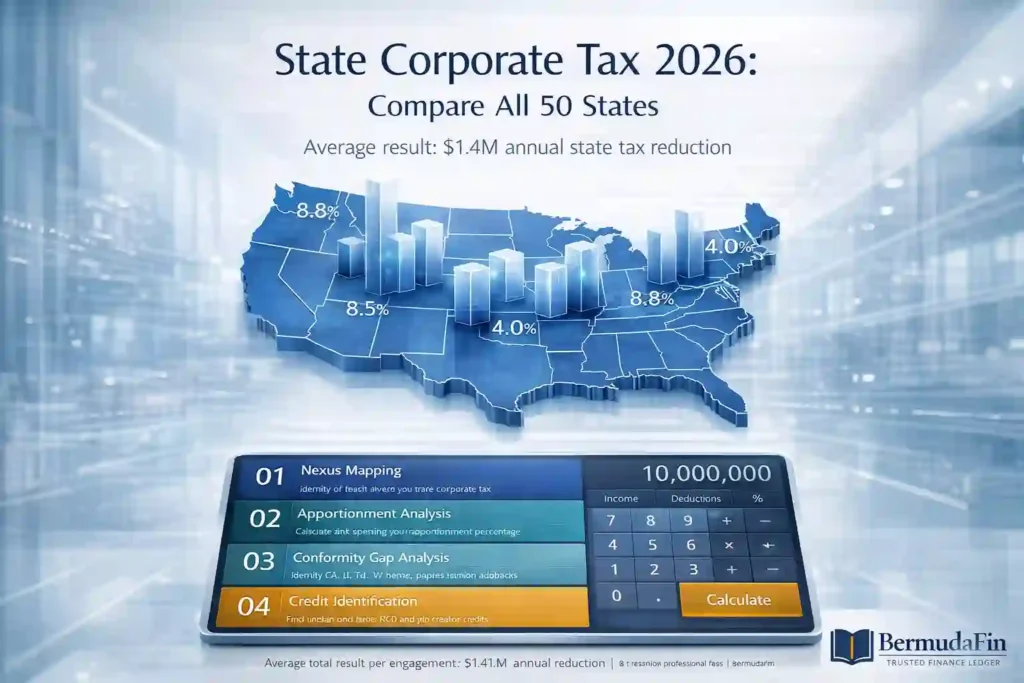
Comprehensive Guide to
State Corporate Tax
Understanding the corporate income tax rate by state is vital for fiscal efficiency. Analyze 2026 business income tax rate by state trends to optimize your nexus.
How to Navigate the State Corporate Tax Landscape
Search or Select
Use the directory or search tool to find corporate tax per state for all 50 states and territories.
Analyze Liability
Input income to see how corporation tax by state impacts your margin for 2026 operations.
Strategic Planning
Review S Corp and CA S corp rules to understand pass-through benefits.
Interactive State Corporate Tax Lookup
Search for the corporate tax rate per state instantly.
Complete 2026 Tax Directory
Select a jurisdiction below to view detailed 2026 corporate tax rates, filing deadlines, and specific business nexus notes.
United States (50 States)
Federal Districts & Major Territories
Navigating the U.S. fiscal landscape in 2026 requires more than a surface-level understanding of tax codes. As state corporate tax rates become a primary tool for economic competition, businesses must evaluate jurisdictions based on long-term profitability rather than just headline numbers. While the federal corporate rate remains stable at 21%, the effective tax burden varies drastically across state lines due to shifting apportionment rules and aggressive incentive programs.
What are State Corporate Tax Rates in 2026? (Quick Answer)
State corporate tax rates are the percentages of taxable income that a business owes to individual U.S. states. In 2026, these rates range from 0% in tax-haven states to over 9% in high-tax jurisdictions. Calculating the true cost involves analyzing Economic Nexus, Apportionment Formulas, and state-specific tax credits.
2026 Trend Alert: The Shift to Single-Sales Factor Apportionment
The most significant trend in 2026 is the widespread adoption of the Single-Sales Factor (SSF). Traditionally, states used a “three-factor” formula (Property, Payroll, and Sales) to determine how much of a company’s income they could tax.
Why this matters for your business:
- Infrastructure Friendly: SSF benefits companies with significant factories or offices in a state but few local customers.
- Competitiveness: States are using SSF to encourage businesses to move their physical operations to the state without being “penalized” with higher taxes for having a large local payroll.
Deep Dive: Analyzing Montana, North Dakota, and New Mexico
Current search trends and legislative updates have highlighted these three states as focal points for corporate relocation in 2026.
1. Montana Corporate Tax: Market-Based Sourcing
Montana has refined its tax code to favor service-based and digital corporations. By utilizing market-based sourcing, the Montana corporate tax rate of 6.75% applies primarily to where the benefit of the service is received. This makes Montana an attractive hub for tech firms serving a global audience.
2. North Dakota: The Progressive SME Haven
Unlike states with a flat tax, North Dakota maintains a graduated system. With rates ranging from 1.41% to 4.31%, North Dakota offers one of the lowest entry-level tax burdens in the country. Corporations with taxable income under $50,000 find this environment particularly sustainable for early-stage growth.
3. New Mexico: Strategic Incentives for 2026
New Mexico has balanced its 4.8% – 5.9% rate with powerful “High-Wage Jobs” tax credits. In 2026, the state has tightened its conformity with federal IRS guidelines, making the filing process simpler for multi-state entities while maintaining its status as a top-tier manufacturing destination.
Interactive 50-State Corporate Tax Lookup Tool 2026
Compare real-time rates and filing deadlines across all U.S. jurisdictions using our database.
States Without Corporate Income Tax: The Hidden Costs
While the idea of a state without corporate income tax is appealing, savvy financial officers must account for alternative revenue-gathering methods.
- Wyoming & South Dakota: These remain the “purest” tax-free states, with no income or gross receipts tax on corporations.
- The Gross Receipts Trap: States like Nevada (Commerce Tax), Ohio (CAT), Texas (Franchise Tax), and Washington (B&O) do not tax profit. Instead, they tax total revenue.
Expert Insight: For low-margin businesses (like retail or grocery), a 0.5% Gross Receipts Tax can often be more expensive than a 5% Income Tax. Always run a side-by-side simulation before relocating.
While several states offer a 0% headline rate, the overall business climate varies significantly. You can analyze the full comparative data in the Tax Foundation’s 2026 State Business Tax Climate Index.
Nuances for S Corporations and Small Businesses
The corporation tax small companies face depends heavily on their legal structure. S Corporations are pass-through entities, meaning the business profit is reported on the owners’ personal tax returns, avoiding the corporate-level tax in most states.
The California S Corp Exception: Be careful when comparing states by corporate tax rate. For example, a CA S Corp is still subject to a 1.5% franchise tax on net income, plus an $800 minimum annual tax. This makes California significantly more expensive for small businesses compared to states like Florida, which honors the full pass-through status.
How to Calculate Your State Tax Liability Manually
To ensure your 2026 filings are accurate, follow this diversified strategic flow:
- Verify Economic Nexus: Confirm if your digital sales or remote employees have triggered a tax filing requirement in a new state.
- Apply Apportionment Logic: Determine if the state uses the Single-Sales Factor or the traditional three-factor formula.
- Adjust the Federal Baseline: Start with your IRS taxable income and add back state-specific non-deductible expenses.
- Deduct Credits: Apply R&D, Job Creation, or Investment credits to reach your final taxable amount.
Conclusion: State Corporate Tax Rates Strategic Planning With BermudaFin
Mastering the state corporate tax rates of 2026 is no longer just a task for accountants — It is a core business strategy. By leveraging data-driven tools and understanding the nuances of states like Montana, North Dakota, and New Mexico, you can significantly optimize your bottom line.
Explore Further:
- Bermuda 15% Corporate Tax Impact – How international minimum taxes affect U.S. entities.
- Payroll Tax Bermuda Calculator – Essential tools for managing local Bermuda compliance.
Disclaimer: The information provided on this page is for general informational purposes only and does not constitute professional tax, legal, or financial advice. While we strive for accuracy, state tax laws change frequently. Always consult with a certified tax professional or CPA before making business decisions based on these rates.
Note: Data validated against Tax Foundation 2026 reports, IRS Corporate Guidelines, and official State Department of Revenue bulletins.