


Your C Corp tax filing deadline is approaching fast.The IRS enforces steeper penalties than ever in 2026 — and I have watched the consequences firsthand.After 18 years of working with C corporations across dozens of industries, I have seen the same pattern repeat itself every single April. Business owners scramble at the last minute, miss critical deductions, and pay penalties that a little preparation would have prevented entirely. In one recent case, a manufacturing client paid $8,400 in combined IRS penalties and interest on a $42,000 tax bill simply because they missed all four quarterly estimated payments. Proper planning would have eliminated that cost completely.
Consequently, this guide exists to break that cycle permanently. It covers everything your C corporation needs to file its 1120 C Corp return correctly, strategically, and on time including three critical areas most competing guides completely ignore: state tax requirements, LLC C corp elections, and mandatory e-filing rules.Think of your C Corp return as your corporation’s annual financial confession to the federal government. Specifically, you must report every dollar earned, every dollar spent, and every dollar owed accurately and completely.
Navigating corporate tax compliance requires precision. With a flat federal tax rate of 21% and strict penalties for non-compliance, corporate officers and tax professionals must adhere rigorously to the Form 1120 instructions to ensure accuracy and avoid costly errors. SDO CPA LLC Do it right and you protect your business, minimize your tax bill, and stay fully compliant. Do it wrong even accidentally and the IRS will find the discrepancy. The question is never whether they will look. The question is whether your 1120 C Corporation return will survive that scrutiny.
What Is C Corp Tax Filing? Understanding the 1120 C Corporation Return
C Corp tax filing is the annual process through which a C corporation reports its financial activity, calculates its federal tax liability, and submits that information to the IRS. Specifically, corporations use Form 1120 to report income, gains, losses, deductions, and credits each year. Additionally, Form 1120 serves as the primary compliance document that C corporations submit to the federal government annually. It also determines exactly how much federal tax the corporation owes ,or how much of an overpayment it may carry forward to future tax years.
The 1120 C Corporation return demands far more than simple number entry. Rather, it requires a comprehensive accounting of your corporation’s full financial year – from the first dollar of gross receipts to the final calculated tax on the last page. Furthermore, you must attach multiple schedules, reconciliation statements, and in many cases supplementary disclosure forms simultaneously. Think of your corporate return as a complete financial audit of your business submitted directly to the most powerful tax agency in the country. The IRS reads every line carefully – and it cross-references your reported numbers against what banks, payroll processors, and 1099 issuers have independently told them about your corporation.
Legal Foundation of the C Corp Return
C corporations exist as legally separate taxpaying entities under U.S. federal law. Unlike S corporations, partnerships, or sole proprietors, a C corporation’s income does not flow through to its owners’ personal returns. Consequently, the corporation itself pays tax directly to the IRS. Corporate officers file the 1120 Corporate Tax Return independently each year to account for all taxable activity. This legal separation creates both strategic opportunity and a direct, unavoidable compliance obligation for every corporation operating in the United States.
How IRS Uses Form 1120 for Audit Selection
The IRS uses the C Corp return to verify that corporations correctly report all income. It also confirms that corporations claim only legally entitled deductions and credits. Furthermore, from an enforcement standpoint, Form 1120 serves as the primary gateway for audit selection. Every discrepancy — no matter how small — can trigger a correspondence notice or a full examination. Accuracy is therefore not merely a best practice for corporations filing their corporate tax return. It is a fundamental business survival strategy that every C corporation officer must take seriously.
How the 1120 C Corp Differs From Other Corporate Returns
Understanding which return your corporation must file is a legal requirement — not optional knowledge. The 1120 C Corp applies exclusively to corporations taxed under Subchapter C of the Internal Revenue Code. S corporations, by contrast, file Form 1120-S as pass-through entities. Partnerships file Form 1065. Sole proprietors report business income on Schedule C attached to their personal Form 1040. Each entity type has its own specific return — and filing the wrong one has serious consequences.
Filing the wrong form does not pause the IRS penalty clock. The agency starts charging penalties from day one. The minimum penalty for a tax return required to be filed in 2026 that is more than 60 days late is the smaller of the tax due or $525. The penalty will not be imposed if the corporation can show that the failure to file on time was due to reasonable cause. Carta The IRS makes no distinction between an accidental error and a deliberate omission when it calculates the initial assessment — and that assessment grows significantly with every passing month.
Who Must Complete C Corp Tax Filing in 2026?
Every domestic C corporation organized under U.S. law must complete C Corp tax filing using Form 1120 each year. Critically, this requirement does not depend on profitability at all. All domestic corporations — including limited liability companies electing to be taxed as corporations — must file Form 1120, regardless of whether they have taxable income. This requirement applies unless the corporation is exempt under Section 501. The obligation to file persists even if the corporation was inactive during the 2025 tax year. SDO CPA LLC In other words, zero revenue does not equal zero filing obligation. Skipping that filing is never acceptable — not even for a dormant corporation that did nothing all year.
The 1120 C Corporation filing requirement covers businesses of every size and across every industry equally. For example, a pre-revenue technology startup incorporated in Delaware must file. Similarly, a profitable manufacturing company earning $5 million annually must also file. Additionally, a corporation that operated for only four months before ceasing operations must file a short-year C Corp return for that period. The complexity of the return scales naturally based on financial activity. Nevertheless, the obligation to file never disappears — regardless of how quiet the business year may have been.

Entities Required to File and Entities That Are Exempt
Importantly, the 1120 C Corp filing requirement covers domestic C corporations and certain foreign corporations with income effectively connected to a U.S. trade or business. Personal holding companies also fall under this requirement. However, several specific categories of entities file different returns instead. S corporations file Form 1120-S. Tax-exempt organizations under Section 501 file Form 990. Real estate investment trusts file Form 1120-REIT. Life insurance companies file Form 1120-L.
The entity’s legal structure — not its revenue type or industry — determines which corporate return it must file. Consequently, corporations with a valid S-corp election under Section 1362 must file Form 1120-S instead of Form 1120. Filing the wrong form — even by honest mistake — can result in penalties. The IRS calculates those penalties as though the corporation filed no return at all — which makes filing the correct form a critical first step in the entire C Corp tax filing process.
LLCs Electing C Corp Taxation — A Critical Filing Requirement Many Miss
This is one of the most misunderstood areas in C Corp tax filing — and most competing guides rarely cover it adequately. All domestic corporations, including limited liability companies electing to be taxed as corporations, must file Form 1120, regardless of whether they have taxable income. SDO CPA LLC Specifically, a domestic LLC elects C corporation taxation by filing Form 8832 with the IRS. This election applies to single-member LLCs, multi-member LLCs, and LLCs in any state. Importantly, a corporation can request an automatic six-month extension by filing Form 7004 by the original due date. For a calendar year corporation, filing Form 7004 by April 15, 2026, extends the filing deadline to October 15, 2026. SDO CPA LLC
Once the election takes effect, the LLC files Form 1120 annually and pays the flat 21% federal corporate tax rate — exactly like any incorporated C corporation. Furthermore, I have worked with several LLC owners who made this election without fully understanding the five-year lock-in rule. One tech startup in California learned this the hard way — they elected C corp taxation in 2023 to attract venture capital, then tried to reverse the election in 2024 when the tax burden proved heavier than expected. The IRS denied the reversal entirely. Consequently, always consult a qualified CPA before making this irreversible commitment.
2026 Federal Tax Rates for C Corp Tax Filing
The federal corporate income tax rate for C Corp tax filing returns submitted in 2026 remains a flat 21% on all taxable income. As of 2026, the federal corporate income tax rate in the United States remains 21%. This flat rate was established under the Tax Cuts and Jobs Act of 2017, which lowered the previous top rate of 35% to make U.S. corporations more globally competitive. The 21% rate applies to all C corporations, regardless of size or industry, and is calculated based on a company’s taxable income after deductions and credits. TaxRavens Unlike the graduated brackets that apply to individual taxpayers, there are no federal income tiers for corporations. Notably, every additional dollar of taxable income costs exactly 21 cents in federal tax — nothing more, nothing less at the federal level alone.
The Flat 21% Rate and What It Means for Your Corporate Return
In practice, that flat structure simplifies rate planning considerably. You always know your marginal rate with certainty when you prepare your 1120 Corporate Tax Return. Income fluctuations during the year change your total tax bill — but they never change the rate itself. However, this structure removes the bracket-threshold strategies that individual taxpayers often use to lower their effective rates. As a result, the entire tax minimization strategy for your C Corp return shifts toward a different and more sophisticated set of tools entirely.
Specifically, you must focus on maximizing deductions, capturing every available credit, and timing income and expense recognition intelligently throughout the year. With a flat federal tax rate of 21% and strict penalties for non-compliance, corporate officers and tax professionals must adhere rigorously to the Form 1120 instructions to ensure accuracy and avoid costly errors. SDO CPA LLC Furthermore, state corporate income taxes add a significant additional layer on top of the federal 21% — a layer we cover in full detail in its own dedicated section below, because most competing guides either skip this topic entirely or treat it as an afterthought.
Key Deadlines and Penalties for 1120 C Corp Filing in 2026
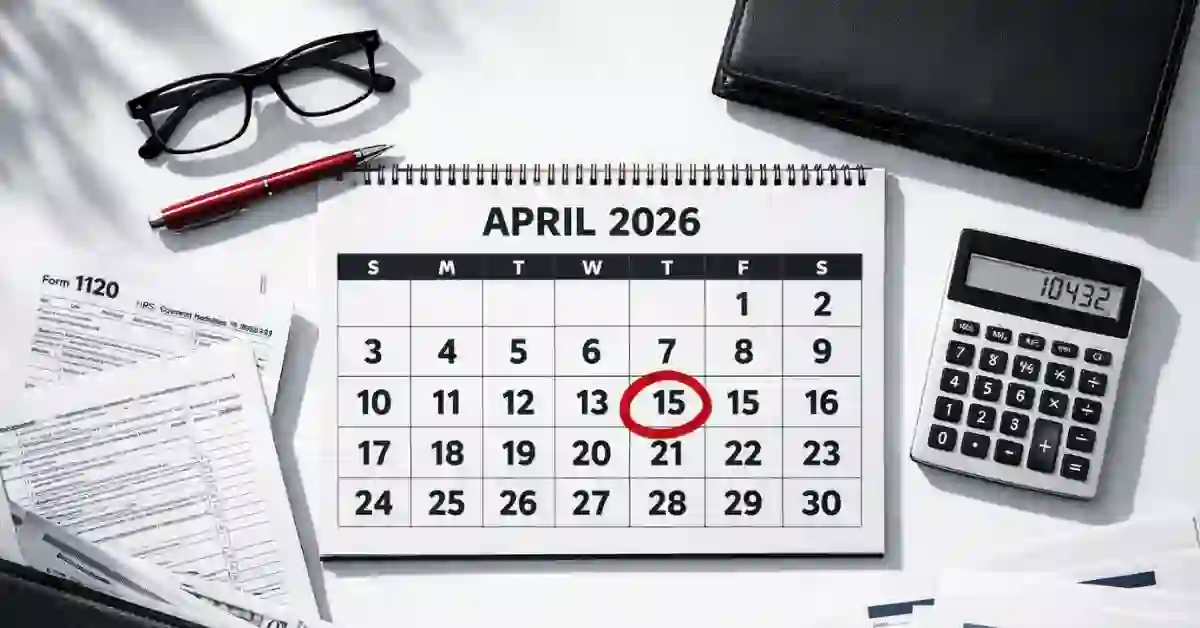
Filing your 1120 C Corp return on time is non-negotiable. C-Corporations follow a different schedule from S-Corps, with a hard deadline of Wednesday, April 15, 2026. Taxzerone Corporations with a short tax year that began before January 1, 2026, and ends on June 30, 2026, must file by September 15, 2026. Form 7004 is used to request an automatic 6-month extension of time to file Form 1120. Corporations with a fiscal tax year ending June 30 will use Form 7004 to request an automatic 7-month extension of time to file Form 1120. Internal Revenue Service.
| Filing Situation | Deadline | Extension Available |
| Calendar-year C-Corps (Dec 31 FYE) | April 15, 2026 | October 15, 2026 via Form 7004 |
| Fiscal-year C-Corps (standard) | 15th day of 4th month after FYE | 6-month extension via Form 7004 |
| Fiscal-year C-Corps (June 30 FYE) | September 15, 2026 | 7-month extension via Form 7004 |
| LLC with C Corp Election (Calendar Year) | April 15, 2026 | October 15, 2026 via Form 7004 |
| Estimated Tax — Q1 2026 | April 15, 2026 | No extension available |
| Estimated Tax — Q2 2026 | June 15, 2026 | No extension available |
| Estimated Tax — Q3 2026 | September 15, 2026 | No extension available |
| Estimated Tax — Q4 2026 | December 15, 2026 | No extension available |
Late Filing vs Late Payment: The Costly Difference Every C Corp Owner Must Know
The IRS punishes failure to file far more harshly than failure to pay. A corporation that does not file its tax return by the due date, including extensions, may be penalized 5% of the unpaid tax for each month or part of a month the return is late, up to a maximum of 25% of the unpaid tax. The minimum penalty for a tax return required to be filed in 2026 that is more than 60 days late is the smaller of the tax due or $525. Carta By comparison, the late-payment penalty runs at only 0.5% per month — still painful, but significantly less severe than the filing penalty.
The IRS assesses separate penalties for late filing and late payment, and they can stack. If both penalties apply in the same month, the late filing penalty is reduced by the late payment penalty. So the combined maximum is 5% per month, not 5.5%, up to a combined maximum of 47.5%. Internal Revenue Service Consequently, these stacked penalties can devastate a corporation’s cash position within just a few months of missing the deadline. Notably, the IRS charges interest on both the unpaid tax and all accrued penalties — calculated daily from the original due date. Always pay your estimated tax balance by April 15 — even when you file an extension.
Why the Extension Rule Traps So Many C Corp Owners Every Year
Many corporations file Form 7004 and immediately assume they now have more time to pay their corporate tax return balance. This assumption is dangerous — and expensive. If your business is not ready to submit Form 1120 by the original due date, you can request an automatic extension using Form 7004. This provides an additional six months to file, but it does not extend your time to pay. Any taxes owed must still be paid by the original due date to avoid interest and penalties. Internal Revenue Service
As a result, every day you delay payment beyond April 15, interest accrues daily on your unpaid 1120 C Corp balance. You must estimate your total tax liability and pay at least 90% of that amount by the original April deadline. Taxzerone Indeed, in my 18 years of practice, this single misunderstanding has cost clients tens of thousands of dollars in completely avoidable interest and penalties. Do not let it trap your corporation in 2026.
E-Filing Requirements for C Corp Tax Filing — What the IRS Demands in 2026

This section covers a critical compliance area that most competing guides skip entirely. Understanding when e-filing is mandatory for your C Corp tax filing prevents technical deficiency notices that trigger additional IRS scrutiny. Specifically, the IRS has significantly tightened these rules in recent years — and the threshold is lower than most business owners realize.
The IRS has significantly tightened the threshold for mandatory electronic filing. For returns filed on or after January 1, 2024, corporations must e-file Form 1120 if they file 10 or more returns of any type during the calendar year. This aggregate count includes income tax returns, employment tax returns like Form 941, and information returns like Forms W-2 and 1099. SDO CPA LLC In practical terms, this means almost every corporation with employees crosses the 10-return threshold and must e-file its 1120 C Corporation return electronically. Consequently, paper filing is no longer an option for the vast majority of active C corporations operating in the United States.
The IRS generally requires corporations with total assets of $10 million or more, or those filing 10 or more returns annually, to e-file their IRS Form 1120. 1-800Accountant Additionally, corporations must use approved software and an authorized e-file provider to submit their return. If your corporation must e-file but submits a paper return instead, the IRS may treat the return as technically deficient. Furthermore, the failure-to-file penalty clock keeps running even though you submitted paperwork — making the e-filing requirement a critical compliance point to confirm with your CPA well before April 15.
How to Confirm Your E-Filing Obligation Before April 15
First, count the total number of returns your corporation filed during the 2025 calendar year. Next, include every Form 941, every W-2, every 1099, and the Form 1120 itself in your count. Then, if that total equals or exceeds 10, your corporation must e-file its corporate tax return electronically. Additionally, if your corporation holds total assets of $10 million or more, e-filing is mandatory regardless of the return count. Ask your CPA to confirm your specific e-filing obligation well before April 15. Do not wait until filing day to discover a compliance requirement that takes time to set up with an authorized e-file provider.
Step-by-Step Guide to Completing Your 1120 Corporate Tax Return
Completing your 1120 Corporate Tax Return for the first time can feel overwhelming. The form runs multiple pages. Required schedules can add dozens of additional pages for corporations with complex financial activity. Understanding the logical structure of your C Corp return, however, transforms this intimidating document into a manageable and systematic workflow. Here is precisely how the key sections fit together from start to finish.

Page 1 of the 1120 C Corporation — Income and Identification
First, Page 1 begins with your corporation’s identifying information. You enter your legal name, Employer Identification Number, date of incorporation, state of incorporation, and total assets at year-end. These details must match your articles of incorporation, state filings, and prior-year returns exactly. Any discrepancy at the identification level delays processing immediately and triggers manual IRS review.
Next, the income section — Lines 1 through 11 — captures all revenue sources for your 1120 C Corporation. This includes gross receipts (Line 1a), cost of goods sold (Line 2), gross profit (Line 3), dividends received (Line 4), interest income (Line 5), rents (Line 6), royalties (Line 7), capital gains (Line 8), and other income (Lines 9–10). Importantly, every line must reconcile perfectly to your financial statements and underlying records. Omitting even a small income category — such as interest earned on a business savings account — frequently triggers IRS notices and time-consuming follow-up inquiries from examiners.
Deductions on Your C Corp Return — Where Real Tax Savings Happen
Subsequently, the deductions section — Lines 12 through 29 — is where legitimate tax reduction happens on your C Corp return. You claim officer compensation (Line 12), wages and salaries (Line 13), repairs (Line 14), bad debts (Line 15), rent (Line 16), taxes and licenses (Line 17), interest expense (Line 18), charitable contributions (Line 19, limited to 10% of taxable income), depreciation (Line 20), advertising (Line 22), pension contributions (Line 23), and employee benefit programs (Line 24). Each deduction category carries specific rules, limitations, and documentation requirements under the Internal Revenue Code.
Specifically, claiming a deduction without adequate substantiation is not aggressive planning — it is an audit invitation. If you lack a receipt, invoice, or contract supporting a deduction, the IRS will disallow it entirely during examination. In fact, maintaining all documentation throughout the year — not just at C Corp tax filing time — is the single most effective habit for protecting your claimed deductions from IRS challenge. Last year, one of my retail clients lost $23,000 in deductions during an IRS examination simply because they could not produce receipts for advertising expenditures they had legitimately paid.
Required Schedules for Your Corporate Tax Return
Beyond Page 1, several key schedules accompany your corporate tax return depending on your corporation’s financial profile. Schedule L provides the corporation’s balance sheet as of the beginning and end of the tax year. Additionally, corporations with total assets of $10 million or more must file Schedule M-3 to answer questions about their financial statements and reconcile net income or loss to taxable income on Form 1120. 1-800Accountant
Furthermore, complete every applicable entry space on Form 1120. Do not enter “See Attached” or “Available Upon Request” instead of completing the entry spaces. Carta The IRS may treat a technically deficient 1120 C Corp return as unfiled. Consequently, the failure-to-file penalty clock keeps running even after you submit the incomplete document. This critically important rule catches many preparers off guard under April deadline pressure — and the financial consequences compound every single month the deficiency remains uncorrected.
Essential Documents for Your C Corp Tax Filing
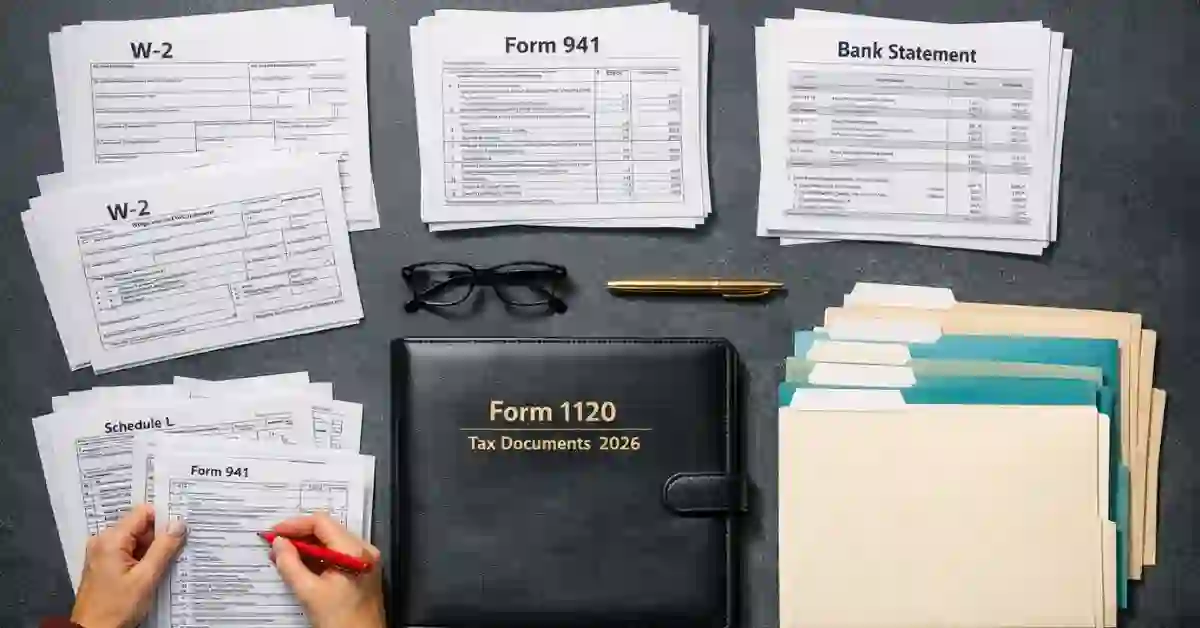
Smart corporations begin gathering documents in January — the moment the tax year closes. Waiting until March or April creates dangerous time pressure. That pressure consistently results in missed deductions, documentation gaps, and preparer errors on the 1120 Corporate Tax Return. Consequently, early preparation delivers one of the highest returns on invested time before filing season begins for any C corporation.
| Document Category | Specific Items Required |
| Financial Statements | Year-end income statement, balance sheet, general ledger trial balance |
| Revenue Records | Gross receipts, sales invoices, 1099-K statements from payment processors |
| Expense Documentation | Receipts, invoices, and contracts for all deducted expenses |
| Payroll Records | W-2s, Form 941s, officer compensation breakdown, payroll summaries |
| Asset & Depreciation | Fixed asset schedule, purchase/disposal records, Form 4562 workpapers |
| Banking & Investments | Year-end bank statements, brokerage statements, 1099-DIV and 1099-INT |
| Prior-Year Returns | Last year’s C Corp return for NOL carryforward amounts and comparison |
| Ownership Records | Cap table, stock ledger, documentation of any ownership changes |
| Foreign Activity | Foreign income documentation, Form 5471 if applicable |
| Credits & Special Items | R&D expense records, energy credit documentation, Form 3800 workpapers |
| LLC Election Records | Form 8832 confirmation letter if LLC elected C corp taxation |
| E-Filing Records | Return count confirmation, authorized e-file provider documentation |
Why Early Document Preparation Directly Reduces Your Corporate Tax Return Liability
In fact, getting organized early accomplishes far more than reducing stress before your C Corp tax filing deadline. It gives your CPA adequate time to identify planning opportunities. It also allows time to catch errors and request missing information — all before deadline pressure creates costly shortcuts. Specifically, corporations that scramble at the last minute consistently leave legitimate deductions unclaimed — the preparer simply lacked the documentation needed to claim those deductions at filing time. Additionally, a well-organized file dramatically reduces audit risk. Clean, reconciled records signal to the IRS that your corporate tax return reflects careful and professional preparation throughout the entire year — not a last-minute assembly job.
State C Corp Tax Filing Requirements in 2026 — A Section Most Guides Skip
Here is the section that most competing guides completely ignore — and it directly affects your corporation’s total tax bill. Federal C Corp tax filing is only one layer of your annual compliance obligation. Notably, most states impose their own separate corporate income tax on top of the federal 21% rate. Forty-four states levy a corporate income tax, with top rates ranging from a 2 percent flat rate in North Carolina to an 11.5 percent top marginal rate in New Jersey. PwC Tax Summaries Additionally, as of 2026, six states do not levy a corporate income tax: Nevada, Ohio, South Dakota, Texas, Washington, and Wyoming. TaxRavens
💡 Quick Tool: Calculating taxes manually across 50 states is complex. Use our State Corporate Tax 2026: 50-State Rates & Calculator to get instant results for your C Corp filing.
No states increased corporate tax rates for 2026, but four states — Georgia, Nebraska, North Carolina, and Pennsylvania — reduced their corporate income tax rates effective January 1, 2026. SK Financial Specifically, North Carolina reduced its flat corporate income tax rate from 2.25% in 2025 to 2% in 2026. Pennsylvania lowered its flat corporate income tax from 7.99% in 2025 to 7.49% in 2026. SK Financial Furthermore, only four states levy a corporate tax rate over 9%: New Jersey (11.5%), Minnesota (9.8%), Illinois (9.5%), and Alaska (9.4%).
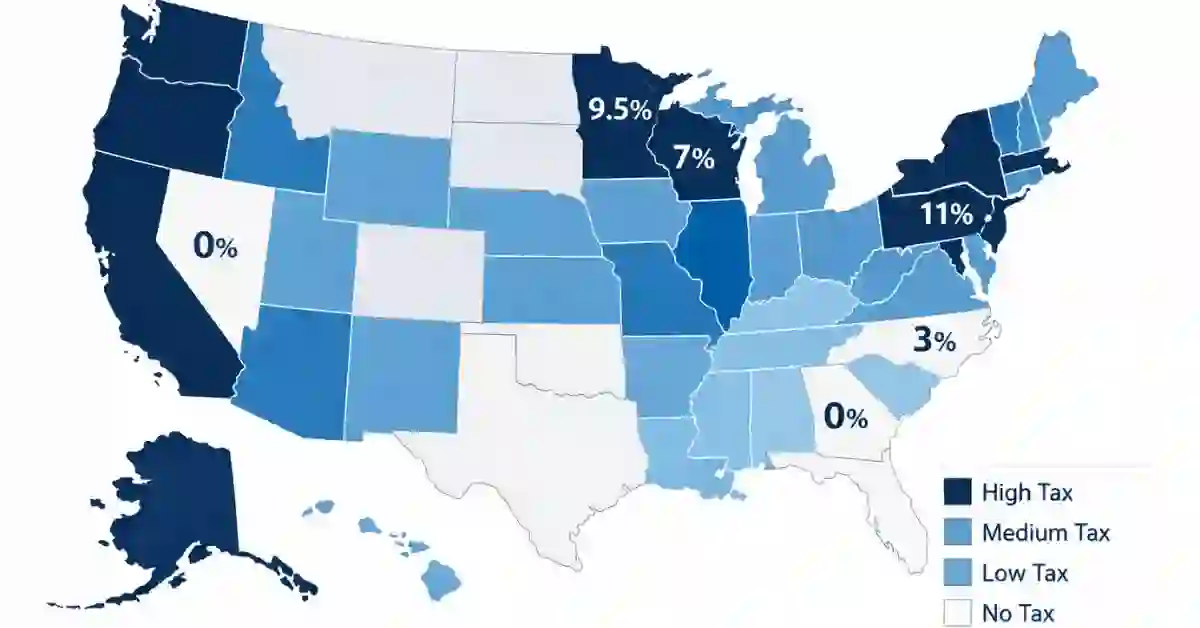
2026 State Corporate Tax Rates — Quick Reference Table
| State Category | States | Corporate Tax Rate |
| No Corporate Tax | Nevada, Wyoming, South Dakota, Ohio, Texas, Washington | 0% (some have gross receipts tax) |
| Lowest Rate | North Carolina | 2.0% |
| Low Rate States | Missouri (4%), Colorado (4.4%), Arkansas (4.3%) | 4%-5% |
| Mid Rate States | Georgia (5.09%), Indiana (4.9%), Kentucky (5%) | 5%-6% |
| Average Rate | Most states | 6.57% average |
| High Rate States | California (8.84%), Connecticut (7.5-8.25%) | 7%-9% |
| Highest Rates | New Jersey (11.5%), Minnesota (9.8%), Illinois (9.5%), Alaska (9.4%) | 9%+ |
💡 Don’t calculate state taxes manually. Use our State Corporate Tax 2026: 50-State Rates & Calculator — enter your taxable income and get your exact state tax liability instantly across all 50 states.
How State Apportionment Rules Affect Your C Corp Return
Importantly, multi-state corporations do not simply pay full state tax on all income in every state where they operate. Instead, states use apportionment formulas to determine what percentage of your corporation’s total income each state can tax. Most states now use a single-factor sales apportionment formula — meaning your state tax obligation in a given state is proportional to the percentage of your total sales that occurred within that state’s boundaries. Some states still use a three-factor formula that weighs sales, payroll, and property together.
As a result, getting this calculation wrong — in either direction — can cost your corporation real money. Overpayment wastes cash. Underpayment, by contrast, triggers state-level penalties and interest in addition to your federal obligations. Consequently, working with a CPA who understands both federal and multi-state C Corp tax filing is essential for any corporation operating across state lines — not a luxury.
State Filing Deadlines and Franchise Tax Obligations
Many states align their C Corp return deadlines with the federal April 15 date — but not all of them. For instance, corporations in Pennsylvania must file between January and June, while specific rules apply to other states based on their individual tax codes. These state rules apply regardless of federal exemptions or extensions. Taxzerone California imposes an $800 minimum franchise tax on all C corporations doing business in the state — regardless of income or profitability — due from the first year of operation. Texas charges a franchise tax due May 15, with an automatic extension available through November 15.
The practical approach: first, identify every state where your corporation has nexus at the beginning of each year. Next, confirm that state’s corporate income tax rate, filing deadline, and any franchise or minimum tax obligations. Then, add all state deadlines to your filing calendar alongside your federal obligations. Finally, confirm your state e-filing requirements — because many states have their own separate electronic filing mandates. Missing a state deadline carries its own separate penalty structure — completely independent of and in addition to any IRS penalties your corporation may already face.
💡 Save Time: Use our State Corporate Tax 2026: 50-State Rates & Calculator to instantly calculate your C Corp’s state tax liability, compare rates across all 50 states, and identify which states offer the most favorable corporate tax environments for your business.
C Corp Tax Filing vs S Corp Filing: Key Differences That Matter
The difference between C Corp tax filing using Form 1120 and S Corp filing using Form 1120-S reflects a fundamental difference in how your business pays tax. A C corporation pays a flat 21% federal tax on profits at the entity level directly. Shareholders then face tax again on their personal returns when they receive dividends. This is the well-known “double taxation” characteristic of the 1120 C Corp structure. By contrast, an S corporation pays no federal entity-level tax at all. Instead, profits pass through directly to shareholders who report them on personal returns at rates from 10% to 37%.

Despite the double-taxation concern, C Corp tax filing status carries significant strategic advantages worth considering carefully. Retained earnings reinvest in the business at the 21% corporate rate — substantially lower than the top individual rate of 37%. This creates a meaningful tax deferral advantage for growth-oriented businesses. Additionally, C-corps carry no restrictions on the number or type of shareholders. They also support multiple classes of stock — essential for venture capital financing and institutional investment. Consequently, businesses planning to pursue outside investment or a public offering must operate as C-corps.
| Factor | C Corp — Form 1120 | S Corp — Form 1120-S |
| Entity-Level Tax | ✅ Yes — flat 21% | ❌ No federal entity tax |
| Pass-Through to Owners | ❌ No | ✅ Yes |
| Double Taxation | ⚠️ Yes — on dividends | ❌ No |
| Shareholder Restrictions | ✅ None | ⚠️ Max 100 shareholders |
| Stock Classes | ✅ Multiple allowed | ❌ One class only |
| VC/Investment Ready | ✅ Yes | ⚠️ Limited |
| Retained Earnings Tax Rate | ✅ 21% flat | ⚠️ Owner’s personal rate |
| Filing Deadline 2026 | April 15, 2026 | March 16, 2026 |
How to Legally Reduce Your 1120 Corporate Tax Return Liability in 2026
Reducing your 1120 Corporate Tax Return liability is entirely legal — when accomplished through IRS-sanctioned deductions, credits, and timing strategies. Specifically, the most impactful tools available in 2026 include accelerated depreciation on qualifying capital investments, the R&D tax credit under Section 41 — a dollar-for-dollar tax reduction, not merely a deduction against income — the Section 179 immediate expensing election for qualifying business assets, and strategic timing of income and expense recognition across tax years.
Furthermore, retirement plan contributions represent a significantly underutilized opportunity for closely held C corporations completing their C Corp return. Contributions to qualified plans — including defined benefit pension plans, 401(k) plans, and SEP-IRAs — are fully deductible by the corporation. Simultaneously, these contributions provide tax-advantaged savings for owner-employees. In fact, one of my technology clients reduced their 2024 Form 1120 tax liability by $67,000 through a combination of R&D credit documentation and a properly structured defined benefit pension plan — both legal, both well-documented, both entirely legitimate. Working with an experienced CPA who specializes in C Corp tax filing is consequently not an expense — it consistently generates measurable, real-dollar savings that most business owners would otherwise miss entirely each year.
Common C Corp Tax Filing Mistakes to Avoid in 2026

After nearly two decades of preparing and reviewing C Corp returns, the same errors surface repeatedly. Importantly, proper preparation and professional guidance prevent almost all of them. Here are the most costly mistakes — and exactly how to avoid each one on your 1120 C Corporation filing in 2026.
Mistake 1 — Misclassifying Owner Compensation on Schedule E
What Reasonable Compensation Means Under IRS Rules
The IRS mandates that C Corp owners who provide substantial services to the business must receive “reasonable compensation” before any non-dividend distributions are made. This means your salary should reflect what an independent employer would pay for a similar position in your specific industry. To determine this value, you should document market research, salary surveys, and the actual time you spend performing executive duties. Consequently, paying yourself a wage that is significantly below market value can lead the IRS to reclassify your distributions as wages, triggering back taxes on payroll.
Zero Salary Red Flag — Why the IRS Looks for This
Reporting zero salary while the corporation generates significant profit is one of the quickest ways to trigger an audit. The IRS views this as an intentional strategy to avoid paying FICA and unemployment taxes. If your C Corp is active and profitable, you must run a formal payroll. Furthermore, a total lack of officer compensation on Form 1120 suggests that the business is either mismanaged or hiding taxable employment events, which prompts immediate federal scrutiny.
Mistake 2 — Failing to Reconcile Book Income to Taxable Income
Schedule M-1 Common Errors and How to Fix Them
Schedule M-1 is the bridge between the net income on your financial books and the taxable income on your return. Common errors often occur when taxpayers fail to account for non-deductible expenses, such as 50% of business meals or specific entertainment costs. To fix these errors, you must systematically track permanent differences (like tax-exempt interest) and temporary differences (like depreciation timing). Accuracy here ensures that your tax return aligns perfectly with your internal accounting records.
Why Book-to-Tax Differences Trigger IRS Audits
Large or unexplained discrepancies between your “book” profit and your “tax” profit signal potential aggressive tax positioning. While some differences are legal and expected, such as using accelerated depreciation for taxes and straight-line for books, a lack of transparency in these adjustments raises red flags. Therefore, inconsistent reporting across these sections suggests to an auditor that the corporation might be underreporting its true economic income.
Mistake 3 — Missing Quarterly Estimated Tax Payments
How Each Quarter Compounds Independently
Many corporations mistakenly believe they can “catch up” on their tax liability at the end of the year. However, the IRS treats each quarter as a distinct deadline. If you fail to pay the required amount in Q1, you begin accruing interest and penalties immediately, even if you overpay in Q4. Because these penalties compound, a single missed payment early in the year can lead to a surprisingly large bill when you finally file your annual return.
Safe Harbor Rules — How to Avoid Underpayment Penalties
To protect your corporation, you should utilize the “Safe Harbor” rules, which allow you to avoid penalties if you pay at least 100% of the tax shown on the prior year’s return (provided the prior year covered 12 months). Alternatively, you can pay 100% of the current year’s estimated tax liability. By staying within these thresholds, you create a legal shield against underpayment penalties, regardless of how much your final year-end tax bill fluctuates.
Mistake 4 — Ignoring State C Corp Tax Filing Obligations
Nexus Rules — When a State Can Tax Your Corporation
“Nexus” refers to the level of connection your corporation has with a state that allows that state to tax your income. In 2026, nexus is no longer just about physical offices; it often includes “economic nexus” triggered by reaching a specific sales threshold or having remote employees in that state. If you sell products or services across state lines, you must evaluate whether your activity has crossed the legal threshold for filing in each jurisdiction.
How to Identify All States Where You Owe Tax
To identify your filing obligations, you should conduct a nexus study that reviews your payroll locations, property ownership, and gross receipts by state. Many states now participate in data-sharing programs with the IRS. As a result, if you file a federal return but ignore a state where you have significant economic activity, the state’s Department of Revenue will likely send an inquiry or a notice of assessment based on shared federal data.
Mistake 5 — Overlooking Mandatory E-Filing Requirements
Paper Return When E-Filing Required — What Happens
The IRS now requires the vast majority of C Corporations to file Form 1120 electronically. If your corporation meets the threshold for mandatory e-filing but you submit a paper return anyway, the IRS may treat the return as “not filed.” This technicality can lead to late-filing penalties that accrue daily, even if you sent the paper documents on time. Always verify your e-file status to ensure the IRS officially accepts your data.
Mistake 6 — Filing a Technically Incomplete 1120 C Corp Return
Entry Space Rule — Never Write “See Attached”
A frequent but costly mistake is writing “See Attached” in the main entry spaces of Form 1120 instead of providing the specific numbers requested. While you can include attachments for additional detail, the primary lines of the tax form must contain the actual totals. The IRS’s automated systems cannot “read” your attachments to find these totals. Consequently, leaving these lines blank often results in the return being rejected or flagged for manual review.
How Incomplete Returns Trigger Ongoing Penalties
When a return is deemed “technically incomplete,” the statute of limitations for an audit never begins to run. This means the IRS can come back years later to challenge your filing. Additionally, the IRS may assess penalties for failure to provide a complete return, which can grow significantly over time. Ensuring every checkbox is marked and every required schedule is fully populated is the best way to close the door on future tax liabilities.
Conclusion: Master Your C Corp Tax Filing Before April 15, 2026

Your C Corp tax filing is the most important annual compliance document your corporation produces. Critically, it is also one of the most powerful tax planning tools available — when you treat it as a strategic exercise rather than a last-minute obligation. With a flat federal tax rate of 21% and strict penalties for non-compliance, corporate officers and tax professionals must adhere rigorously to the Form 1120 instructions to ensure accuracy and avoid costly errors. SDO CPA LLC Specifically, the primary opportunity for reducing your tax bill lies in maximizing legitimate deductions, capturing every available credit, making smart timing decisions, and addressing your state filing obligations consistently throughout the year.
C-Corporations follow a hard deadline of Wednesday, April 15, 2026. Taxzerone File Form 7004 by April 15 for an automatic 6-month extension. However, the extension does not extend your time to pay. You are still responsible for paying by the original deadline to avoid underpayment penalties. Internal Revenue Service Consequently, start gathering your financial records now. Review your quarterly estimated payments carefully. Confirm your e-filing obligations. Check every state where your corporation has nexus — and use our State Corporate Tax 2026: 50-State Rates & Calculator to calculate your combined federal and state liability instantly.
Professional recommendation from 18 years of C Corp tax practice
Schedule your corporate tax planning meeting no later than February of each year. Use that session to review financial statements, project your corporate tax return liability, identify deduction and credit opportunities, confirm your e-filing obligations, and map out all state filing deadlines alongside your federal calendar. In fact, proactive planning always costs less — in time, money, and stress — than reactive problem-solving after an IRS notice arrives on your desk.
⚠️ DISCLAIMER: This article provides general educational information about C Corp tax filing requirements. It does not constitute professional tax or legal advice. Tax laws change frequently. Always consult a licensed CPA, enrolled agent, or tax attorney for advice specific to your corporation’s situation before filing any tax return with the IRS.
For personalized guidance on your C Corp tax filing, consult a licensed CPA or enrolled agent with documented expertise in U.S. corporate tax law. The IRS also provides free official resources at IRS.gov/corporations.
FAQ: About C Corp Tax Filing
- 1. What is C Corp tax filing and what form do C corporations use?
C Corp tax filing is the annual process of reporting income, deductions, credits, and tax liability to the IRS. All domestic corporations must file Form 1120, regardless of whether they have taxable income. This requirement applies unless the corporation is exempt under Section 501. SDO CPA LLC Every domestic C corporation must complete this filing annually — regardless of income level, profitability, or business activity during the period. Specifically, failure to file triggers immediate penalties even for inactive corporations with zero revenue.
- 2. When is the 1120 C Corp filing deadline for 2026?
C-Corporations follow a hard deadline of Wednesday, April 15, 2026. Taxzerone Corporations with a short tax year that began before January 1, 2026, and ends on June 30, 2026, must file by September 15, 2026. Form 7004 is used to request an automatic 6-month extension of time to file Form 1120. Internal Revenue Service Consequently, the extended deadline for calendar-year filers using Form 7004 is October 15, 2026 — but that extension covers paperwork only, not payment.
- 3. Can an LLC file as a C corporation using Form 1120?
Yes — and this is more common than many business owners realize. All domestic corporations, including limited liability companies electing to be taxed as corporations, must file Form 1120, regardless of whether they have taxable income. SDO CPA LLC Specifically, an LLC makes this election by filing Form 8832 with the IRS. Once the election takes effect, the LLC files Form 1120 annually and pays the flat 21% federal corporate tax rate. Importantly, the LLC cannot reverse this election for five years — so always consult a CPA before making this commitment.
- 4. What is the penalty for filing a C Corp return late in 2026?
A corporation that does not file its tax return by the due date may be penalized 5% of the unpaid tax for each month or part of a month the return is late, up to a maximum of 25% of the unpaid tax. The minimum penalty for a tax return required to be filed in 2026 that is more than 60 days late is the smaller of the tax due or $525. Carta Furthermore, the IRS assesses separate penalties for late filing and late payment, and they can stack — up to a combined maximum of 47.5%. Internal Revenue Service
- 5. Does a C corporation with zero income still need to file Form 1120?
Absolutely yes. All domestic corporations must file Form 1120, regardless of whether they have taxable income. The obligation to file persists even if the corporation was inactive during the 2025 tax year. SDO CPA LLC A zero-income C Corp return confirms to the IRS that the corporation was inactive during the period. Consequently, failure to file — even for an inactive corporation — triggers the same failure-to-file penalties the IRS applies to profitable corporations.
- 6. What state corporate tax rates apply to C corps in 2026?
Forty-four states levy a corporate income tax, with top rates ranging from a 2 percent flat rate in North Carolina to an 11.5 percent top marginal rate in New Jersey. PwC Tax Summaries As of 2026, six states do not levy a corporate income tax: Nevada, Ohio, South Dakota, Texas, Washington, and Wyoming. TaxRavens Use our State Corporate Tax 2026: 50-State Rates & Calculator to instantly calculate your exact state tax liability for your specific C Corp situation.


Pingback: BMA Regulations 2026: Complete Bermuda Guide