


On January 22, 2026, the Bermuda Monetary Authority released its annual Business Plan, signaling major shifts in BMA Regulations 2026. This updated framework directly impacts your compliance obligations, licensing timelines, and capital planning. Consequently, offshore investors must immediately adapt to stricter Basel III rules, supervisory consolidation, and the full enforcement of the Beneficial Ownership Act. Bermuda remains a premier financial hub, managing over $800 billion in assets. However, navigating this new layer of regulatory sophistication now requires absolute precision and speed. Therefore, this comprehensive guide breaks down the updated compliance process step-by-step to keep your business ahead of regulators.
📌 Quick Update: Looking for the official Bermuda Monetary Authority fee schedules? Download the latest PDFs directly from the official BMA database:
- 👉 Download Official 2026 BMA Fees Schedule PDF (Current Year)
- 👉 Download 2025 BMA Fees Schedule PDF (Previous Year)
BMA Regulations: Understanding Bermuda’s Regulatory Framework in 2026
BMA Regulations govern the licensing, supervision, and compliance requirements for Bermuda’s financial services sector, including banks, insurers, investment funds, trust companies, and digital asset businesses. The Bermuda Monetary Authority (BMA) regularly updates its regulatory guidance, application procedures, and fee schedules to strengthen market integrity and investor protection. Therefore, businesses should review the latest Bermuda Monetary Authority investment fund fees 2026 PDF and other official regulatory documents before submitting applications or annual filings. In addition, investment fund managers should confirm the current Bermuda Monetary Authority investment fund application fee and ongoing compliance obligations to avoid delays or penalties. By following BMA Regulations and monitoring official updates, organizations can maintain regulatory compliance, reduce operational risk, and build long-term confidence with investors and stakeholders.
BMA 2026 Business Plan: 5 Major Updates You Cannot Ignore
The BMA Regulations 2026 Business Plan is not a routine update. It represents a structural shift in how Bermuda regulates its financial services sector. Here are the five changes that carry the most immediate impact for offshore investors and financial institutions.
| Regulatory Area | Key Change | Effective Timeline | Business Impact |
| Insurance Licensing | IALC forms simplified; PSPI class introduced | Q1 2026 | 30% faster approvals |
| Banking Regulation | Basel III Large Exposure framework mandatory | Immediate (Jan 2026) | Capital hike of $5M+ for larger entities |
| AML / ATF | High-risk jurisdiction Enhanced Due Diligence advisory | February 2026 | Stricter KYC requirements |
| Recovery Planning | Updated Guidance Note for insurers | March 2026 | Mandatory stress testing |
| Beneficial Ownership | BO Act 2025 full enforcement begins | November 2025 – Q1 2026 | Register by March 31, 2026 |
1. Insurance Licensing: IALC Simplification and the New PSPI Class
The BMA has streamlined the Insurance Application and Licensing Checklist (IALC) forms as part of its Q1 2026 reform package. According to the BMA’s official licensing guidance, processing times are expected to drop by approximately 30%, which means applicants who previously waited 120 to 150 days can now realistically expect approval within 90 days when all documents are in order.
The introduction of the Innovative Insurer / Product-Specific Property and Infrastructure (PSPI) class is the most notable new development. This category specifically targets insurers in infrastructure risk, renewable energy projects, and product-specific coverage lines that did not fit neatly into existing classes. If you are structuring a vehicle for climate-linked or infrastructure insurance exposure, the PSPI class eliminates the previous need for bespoke exemptions.
Pro Tip: Applicants who complete their Beneficial Ownership registration before submitting their IALC application report significantly fewer requests for additional information from the BMA. Get your BO registration done first.
2. Banking Regulation: Basel III Large Exposure Rules Are Now Mandatory
Effective immediately from January 2026, the BMA requires Bermuda-licensed banks to comply with Basel III Large Exposure (LE) standards. This framework, aligned with the Bank for International Settlements Basel III framework, limits a bank’s net exposure to a single counterparty to no more than 25% of its eligible capital base.
For investors who hold banking licenses or invest in Bermuda-domiciled banking vehicles, the capital implications are material. An institution with $20 million in eligible capital now faces a hard $5 million cap on any single-name exposure. Institutions that currently exceed these thresholds must submit a remediation plan to the BMA within 90 days of the January 2026 effective date.
3. AML/ATF: Enhanced Due Diligence for High-Risk Jurisdictions
Effective February 2026, the BMA issued an updated advisory identifying several jurisdictions as high-risk for anti-money laundering (AML) and counter-terrorist financing (ATF) purposes. The advisory aligns closely with the FATF grey list and requires all BMA-regulated entities to apply Enhanced Due Diligence (EDD) when transacting with counterparties, beneficial owners, or source-of-funds connected to these jurisdictions.
In practical terms, this means more documentation, longer onboarding timelines, and more frequent transaction monitoring for affected relationships. Compliance officers should update their KYC frameworks immediately and ensure their transaction monitoring systems can flag high-risk jurisdiction connections automatically.
4. Recovery Planning: Updated Guidance Note for Insurers
By March 2026, commercial insurers and reinsurers licensed in Bermuda must comply with the BMA’s Updated Guidance Note on Recovery Planning. The revised guidance requires entities to conduct forward-looking stress tests that model severe but plausible scenarios, including catastrophic loss events, counterparty defaults, and sudden liquidity shocks.
This is not a checkbox exercise. The BMA Regulations expects detailed narrative responses alongside quantitative modelling, and it will review recovery plans as part of its supervisory cycle. Entities that lack in-house actuarial capacity should engage external advisors well before the March deadline.
5. Beneficial Ownership Act 2025: The March 31 Deadline Is Non-Negotiable
The Beneficial Ownership (BO) Act 2025 entered full enforcement mode between November 2025 and Q1 2026. Every BMA-licensed entity must identify and register all beneficial owners who directly or indirectly hold 25% or more of shares or voting rights, or who exercise control through other means. The registration deadline is March 31, 2026. Entities that miss this date face immediate adverse consequences, including license suspension, civil penalties, and reputational damage that can affect correspondent banking relationships. The BMA has made clear that it will not grant extensions without extraordinary justification.
Critical Deadline Alert: March 31, 2026 is the final date for Beneficial Ownership registration. Begin this process immediately if you have not already done so. Delays in BO registration are now the leading cause of licensing application rejections.
Step-by-Step BMA Licensing Process 2026

Obtaining a BMA license in 2026 requires careful sequencing. The process is more transparent than many offshore jurisdictions, but it demands discipline and preparation. Here is the complete walkthrough.
Step 1 — Pre-Application Preparation (Allow 30 Days)
Start by developing a comprehensive business plan that clearly articulates the regulatory class you are targeting, your projected financial position for the first three years, and your governance structure. Next, appoint a qualified compliance officer who meets BMA fit-and-proper requirements. This person must be named in the application.
Complete your Beneficial Ownership registration through the Bermuda Registry before touching the IALC forms. This single step eliminates the most common delay in the application review process. Finally, assemble certified copies of constitutional documents, ownership charts, audited financial statements for the prior two years, and professional references for all senior officers.
Step 2 — Submit Application via BMA Portal
All applications now pass through the BMA’s online portal. Application fees range from $5,000 for smaller Class A entities to $25,000 for larger commercial insurers and banks. Fee schedules are tiered by license class and expected gross premium or asset volume. Pay attention to the specific fee schedule for your target license class, as underpayment triggers immediate administrative rejection without refund of submission costs.
Step 3 — Review Period (90 to 120 Days Average)
The BMA’s review process operates in three phases. During Phase One (days 1 to 30), the authority conducts a completeness check and returns incomplete applications. During Phase Two (days 31 to 90), the substantive review occurs, during which the BMA Regulations may issue a Request for Additional Information (RFAI). Respond to every RFAI within 14 days to keep your application active. Phase Three (days 91 to 120) involves final committee approval and license issuance.
Step 4 — Post-Approval Obligations
Once you receive your license, register with the Bermuda Stock Exchange (BSX) if applicable. Appoint a BMA-approved external auditor within 60 days of license issuance. File your first regulatory return within 90 days of the financial year-end following licensing. Maintain minimum capital levels at all times and report any breach to the BMA within 10 business days.
Download Tip: The BMA publishes its full fee schedule and application forms at bma.bm/authorisation. Bookmark this page and check it before every submission because fee schedules are updated annually.
US and UK Investor Compliance: Your Unique Edge

Investors from the United States and the United Kingdom face an additional layer of home-country reporting obligations when using Bermuda structures. Understanding these obligations upfront transforms a potential compliance headache into a genuine competitive advantage.
US Investors: IRS-FATCA and BMA CRS 2.0 Integration
Bermuda is a FATCA-compliant jurisdiction operating under Model 2 Intergovernmental Agreement terms. This means Bermuda financial institutions report US account holder information directly to the IRS, with BMA Regulations oversight ensuring local institutions meet their FATCA obligations. You can review current FATCA requirements directly on the IRS FATCA portal.
For 2026, the critical development is the implementation of CRS 2.0 (Common Reporting Standard version 2.0), which expands the reporting perimeter to include crypto assets and certain digital investment accounts. If you hold interests in a Bermuda structure that touches digital assets, you must ensure the structure is CRS 2.0 compliant before the end of Q2 2026.
Key filing requirements for US investors using Bermuda structures:
- FATCA Form 8938 filing threshold is $50,000 for individuals filing separately and $100,000 for married couples filing jointly.
- FBAR (FinCEN 114) is required for accounts exceeding $10,000 at any point during the year.
- Passive Foreign Investment Company (PFIC) rules apply to certain Bermuda fund structures. Elect QEF status where possible to avoid punitive tax treatment.
UK Investors: HMRC Rules for Bermuda Investments
UK residents who invest into Bermuda-domiciled structures must comply with HMRC’s offshore reporting obligations under the International Tax Compliance Regulations 2015, which implement CRS directly into UK law. Since Brexit, the UK operates its own standalone CRS framework, and Bermuda reports UK account holder data to HMRC independently of any EU mechanism.
Bermuda investments qualify as permitted offshore holdings under UK law, but the tax treatment depends heavily on the investor’s domicile status, residency, and the structure of the vehicle. UK-resident non-domiciled investors who previously used the remittance basis should note that the remittance basis regime was abolished from April 6, 2025, replacing it with a four-year foreign income and gains exemption for new UK arrivals. This change directly affects how Bermuda-sourced returns are taxed for many high-net-worth UK investors.
Additional obligations for UK investors using Bermuda structures:
- Report all foreign income and gains from Bermuda structures on your Self Assessment tax return under the Foreign pages (SA106).
- Controlled Foreign Company (CFC) rules under the Corporation Tax Act 2010 can attribute profits of a Bermuda entity back to a UK corporate investor if the entity is controlled from the UK and no genuine exemption applies.
- The Trust Registration Service (TRS) requires UK-connected trusts, including those with a UK resident trustee or beneficiary, to register with HMRC even when the trust is domiciled in Bermuda.
- UK investors in Bermuda funds classified as offshore funds must check whether the fund holds Reporting Fund status with HMRC. Without it, gains are taxed as income rather than capital gains, which carries a significantly higher tax rate for additional-rate taxpayers.
- Register with Companies House for any UK-connected entity disclosures required under the Economic Crime (Transparency and Enforcement) Act 2022, which extended Register of Overseas Entities obligations to British Virgin Islands and Bermuda-domiciled vehicles holding UK property.
Planning Note:
UK investors who structure Bermuda holdings through a properly constituted offshore fund with HMRC Reporting Fund status can access the 24% capital gains rate rather than the 45% additional income tax rate on fund distributions. This single structural decision can represent a material difference in after-tax returns over a five to ten year holding period. Confirm Reporting Fund status at the HMRC offshore funds register before committing capital.
Tax Efficiency: Bermuda vs Cayman Islands Comparison
Quick Tool: Calculating taxes manually across 50 states is complex. Use our State Corporate Tax 2026: 50-State Rates & Calculator to get instant results for your C Corp filing.
| Entity Type | Bermuda Tax | Cayman Tax | Est. Setup Cost | Regulatory Oversight |
| Offshore Exempted Company | 0% | 0% | $12,000 – $18,000 | BMA (moderate) |
| Discretionary Trust | 0% | 0% | $8,000 – $12,000 | BMA Trust Regulations |
| Insurance Company (Class A) | 0% on premiums | 0% on premiums | $35,000 – $60,000 | BMA (intensive) |
| Open-Ended Investment Fund | 0% | 0% | $20,000 – $40,000 | BMA ISCA |
| Digital Asset Business | 0% | 0% | $25,000 – $50,000 | BMA DABA 2023 |
Both Bermuda and Cayman offer zero corporate income tax, zero capital gains tax, and zero withholding tax. The distinction lies in regulatory quality and market access. Bermuda’s BMA is widely recognized as the more rigorous regulator, which translates into greater acceptance by institutional counterparties, US reinsurance markets, and European cedants. If your business model requires credibility with sophisticated institutional partners, Bermuda’s regulatory overhead is worth the investment.
2026 BMA Penalties and Enforcement: Real Consequences for Non-Compliance

The BMA has significantly expanded its enforcement toolkit since 2023. The 2026 Business Plan explicitly signals that supervisory actions will increase in frequency and severity. These are not abstract risks. They are documented consequences that have already affected real market participants.
AML and ATF Violations
Entities that fail to implement adequate AML/ATF controls face financial penalties starting at $500,000 for first violations and exceeding $1,000,000 for repeat or egregious breaches. The BMA has the authority to impose these penalties without court involvement through its administrative enforcement process. In 2025, four Bermuda-licensed entities received public censure notices for AML control failures, all reported in the Royal Gazette and creating lasting reputational damage for affected firms.
Beneficial Ownership Filing Failures
Missing the March 31, 2026 BO registration deadline is treated as a material compliance failure. The BMA may issue a Director General’s Direction, which can include immediate suspension of the entity’s license pending remediation. License suspension triggers cross-default clauses in many institutional agreements and can freeze operational bank accounts. Recovery from a suspension event typically takes three to six months and costs significantly more than timely compliance would have.
Basel III Capital Breaches
Banks that fail to maintain Basel III Large Exposure compliance face escalating supervisory intervention. Stage one involves a formal warning and a mandatory remediation plan. Second Stage, triggered if the breach persists beyond 90 days, involves enhanced reporting requirements and possible restrictions on new business. Stage three involves enforcement action, which can include license revocation.
Experience Note: Compliance professionals who have worked through BMA enforcement processes consistently report that early voluntary disclosure of breaches results in significantly better outcomes than situations where the BMA discovers violations independently. The BMA Regulations has an active supervisory examination programme and it will find issues eventually.
Key Compliance Deadlines: BMA 2026 Calendar
Use this table as your master reference for every BMA Regulations 2026 deadline.
| Deadline | Obligation | Who It Affects | Risk of Missing |
| January 2026 (Immediate) | Basel III Large Exposure compliance | All licensed banks | Enforcement action within 90 days |
| February 2026 | Updated AML/ATF EDD implementation | All regulated entities | Supervisory review trigger |
| March 31, 2026 | Beneficial Ownership registration | All licensed entities | License suspension |
| March 2026 | Recovery Plan submission | Commercial insurers and reinsurers | Regulatory breach finding |
| Q2 2026 | CRS 2.0 implementation for digital assets | Funds and banks with crypto exposure | FATCA/CRS reporting failure |
| Q3 2026 | Licensing rush period begins | New applicants | Extended processing delays |
2025 vs 2026: What Changed Under BMA Regulations
| Regulatory Area | 2025 Position | 2026 Position | Action Required |
| IALC Forms | Complex multi-form process | Simplified; PSPI class added | Update application preparation |
| Basel III LE | Advisory only | Mandatory enforcement | Capital review immediately |
| BO Act | Registration phase | Full enforcement | Register by March 31 |
| AML EDD | Standard risk-based approach | Enhanced; high-risk jurisdiction list updated | Update KYC frameworks |
| CRS Reporting | CRS 1.0 | CRS 2.0 includes crypto assets | Expand reporting systems |
| Recovery Planning | Encouraged for large insurers | Mandatory; updated Guidance Note | Submit by March 2026 |
BMA Historical Fee Schedules Archive (2016 – 2024)
If you are auditing past financial records or performing historical compliance analysis, you can access previous years’ official fee structures below:
- BMA Fees Schedule 2024 PDF
- BMA Fees Schedule 2023 PDF
- BMA Fees Schedule 2022 PDF
- BMA Fees Schedule 2021 PDF
- BMA Fees Schedule 2020 PDF
- BMA Fees Schedule 2019 PDF
- BMA Fees Schedule 2018 PDF
- BMA Fees Schedule 2017 PDF
- BMA Fees Schedule 2016 PDF
Future Outlook: BMA Fintech Strategy 2026 to 2028

The BMA Regulations 2026 Business Plan is not purely about tightening existing rules. It also signals a forward-looking agenda for financial innovation that creates real opportunities for investors who position early.
Digital Asset Sandbox Expansion
The BMA is actively expanding its Digital Asset Business Act (DABA) sandbox programme through 2026 and 2027. The expanded sandbox allows fintech companies to test digital asset products under regulatory supervision with reduced capital requirements and a streamlined compliance burden during the testing phase. Successful sandbox participants receive a clear pathway to full DABA licensing.
How to Submit Fees to the Bermuda Monetary Authority?
“The BMA allows registered entities and investment funds to settle their regulatory and application licensing fees online. For step-by-step wire transfer and digital portal instructions, you can read the official BMA Online Payment Ability Notice PDF.”
Understanding BMA Section 17(1)(ba) and 17(1)(c) Requirements
Under the Bermuda Monetary Authority regulations, investment funds matching the Professional Class A category must adhere to strict filing timelines. Specifically, pursuant to Section 17(1)(ba), operators must clear an initial filing fee of $1,100 at the immediate time of application. Furthermore, registered funds must maintain ongoing regulatory compliance by submitting the mandatory annual fee of $1,100 outlined under Section 17(1)(c). Failure to meet these financial compliance updates before local deadlines can disrupt operational licensing in the Hamilton financial district.
| BMA Investment Fund Category / Section | Fee Type | Official 2026 Fee Amount (BMD/USD) |
|---|---|---|
| Section 17(1)(ba) – Professional Class A Fund | Initial Filing Fee | $1,100 |
| Section 17(1)(c) – Professional Class A Fund | Annual Fee | $1,100 |
| Professional Fund Application | Standard Registration Fee | $1,500 |
| Bermuda Investment Manager | Registration Fee (BMA) | $2,500 |
Electronic Money Institution Licensing
The BMA plans to introduce a simplified Electronic Money Institution (EMI) licensing track in 2026 and 2027. This track targets payment technology companies and digital wallet providers that want a reputable offshore domicile without the full burden of a banking license. The EMI license carries lower minimum capital requirements, a faster review process, and fewer ongoing reporting obligations than a full banking license.
This development is particularly relevant for Indian fintech founders who want to build cross-border payment infrastructure with a credible regulatory anchor. Bermuda’s EMI license, combined with India’s UPI international expansion, creates an interesting infrastructure opportunity for the 2026 to 2028 period.
Climate Risk and ESG Insurance Framework
The BMA is developing a dedicated climate risk supervisory framework for the insurance sector, expected to take shape through 2026 and 2027. This framework will require larger insurers to disclose climate-related financial risks using TCFD-aligned methodologies and to demonstrate that their underwriting and investment portfolios account for transition and physical climate risks.
For investors building sustainable or ESG-focused insurance vehicles, this regulatory development creates a first-mover advantage. Structures designed with TCFD alignment from inception will be well ahead of the compliance curve when mandatory requirements arrive.
Take Action Now: Apply Before the Q3 Rush
The BMA 2026 Business Plan creates a defined compliance landscape with hard deadlines, real penalties, and genuine opportunities. Every investor who acts in Q1 and Q2 2026 will process faster, face fewer regulatory friction points, and be better positioned to capitalize on Bermuda’s expanding fintech and digital asset licensing frameworks. The most time-sensitive action is Beneficial Ownership registration before March 31, 2026. If your entity is not registered, start the registration process today. Everything else flows from that foundation. Once your BO registration is complete, align your capital planning with Basel III LE requirements, update your KYC and AML frameworks for the February 2026 advisory, and engage your compliance team on the recovery planning guidance if you operate insurance vehicles.
Q3 2026 will bring a surge of license applications as the regulatory framework settles and investors who delayed action rush to catch up. Those who file complete, well-prepared applications in Q1 and Q2 will receive their licenses faster, with fewer RFAI rounds, and with more regulatory goodwill. The BMA rewards preparation.
Subscribe to the bermudafin.com newsletter for monthly BMA updates, deadline reminders, and regulatory alerts delivered directly to your inbox.
FAQ: BMA Regulations 2026
- How will insurance licensing become faster under BMA 2026 regulations?
The BMA has simplified the IALC forms and introduced the new PSPI class as part of its Q1 2026 reform agenda. The new forms reduce duplicative documentation requirements and introduce a pre-screening pathway for straightforward applications. Combined, these changes are expected to reduce average approval timelines by approximately 30%, bringing most applications from 120 to 150 days down to 90 to 120 days.
- What is the minimum capital requirement for a Bermuda bank license?
Class A banks require minimum paid-up capital of approximately $10 million. Under the Basel III Large Exposure framework mandatory from January 2026, your capital base also determines your maximum single-counterparty exposure, which is capped at 25% of eligible capital. A bank with $20 million in eligible capital therefore has a $5 million large exposure limit. Prospective applicants should engage a BMA-approved advisor to structure their capital base appropriately before filing.
- What is the BO Act compliance deadline?
The hard registration deadline for all BMA-licensed entities is March 31, 2026. Entities must identify all beneficial owners who hold 25% or more of shares or voting rights, or who exercise effective control through other means, and register this information with the Bermuda Registry. Missing this deadline risks immediate license suspension with no automatic grace period.
- Does Bermuda have any corporate income tax in 2026?
Bermuda does not impose corporate income tax, capital gains tax, or withholding tax on dividends and interest for exempted entities. However, home country tax obligations such as US Subpart F rules, PFIC rules, or India’s DTAA provisions continue to apply to Bermuda-sourced income. The BMA 2026 Business Plan introduces no new tax measures, and Bermuda’s commitment to tax neutrality remains unchanged.
- How do CRS 2.0 changes affect Bermuda investments?
CRS 2.0 expands the reporting framework to include crypto assets and digital investment accounts held through Bermuda financial institutions from Q2 2026. If you hold digital assets through a Bermuda-domiciled fund, exchange, or custodian, that entity must now report your account information to your country of tax residence. US investors are primarily affected through their FATCA obligations. Non-US investors from CRS participating countries including India, the UK, and EU member states will see their Bermuda digital asset holdings reported to their home tax authorities.
Disclaimer
The information provided in this article is for general educational and informational purposes only. It does not constitute legal, financial, tax, or regulatory advice. While we have made every effort to ensure accuracy as of the date of publication, BMA Regulations, deadlines, and compliance requirements are subject to change without notice. Always consult a qualified legal counsel, licensed financial advisor, or BMA-approved compliance professional before making any investment, licensing, or regulatory decisions related to Bermuda-domiciled structures. Reliance on any information in this article without independent professional verification is at your own risk.This article does not establish a client-advisor relationship between the reader and the author or publisher.
Sources & References
1. Bermuda Monetary Authority (BMA) — Official Website Primary regulatory authority for all BMA licensing, supervision, and enforcement matters. 🔗 https://www.bma.bm/
2. BMA 2026 Business Plan Official annual business plan released January 22, 2026, covering supervisory priorities and regulatory updates. 🔗 https://www.bma.bm/about-bma/business-plan





Pingback: Bermuda Economic Substance Requirements: 2026 US Tax Guide
Pingback: Bermuda Monetary Authority New Regulations 2026 Outlook
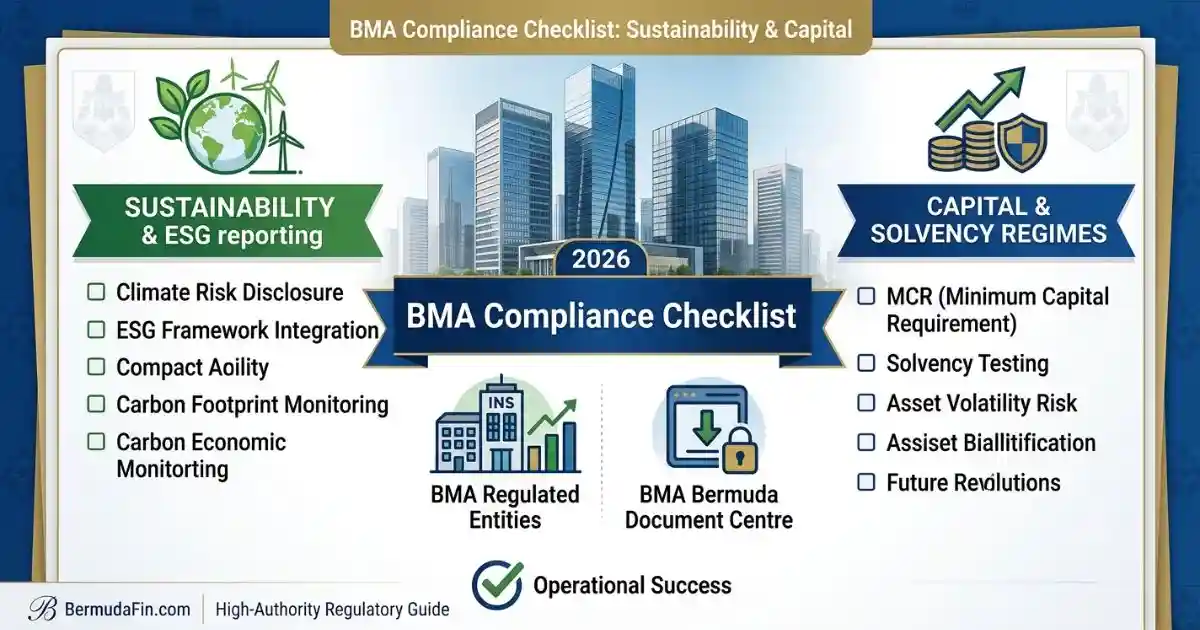
Pingback: BMA Compliance Checklist: Sustainability & Capital