
Introduction
The Bermuda Government Financial Outlook has entered one of the most significant transition periods in the island’s modern economic history. For decades, Bermuda built its international reputation as a leading offshore financial center with no traditional corporate income tax for most businesses. Today, the country is adapting to global tax reforms while protecting its competitiveness, strengthening public finances, and investing in essential public services. This shift is not simply about introducing new taxes. Instead, it represents a broader strategy to create a resilient economy capable of supporting long-term growth without compromising Bermuda’s attractiveness to international investors. According to the latest Government of Bermuda Budget Statement, policymakers are combining fiscal discipline with targeted tax relief, infrastructure spending, and debt reduction initiatives.
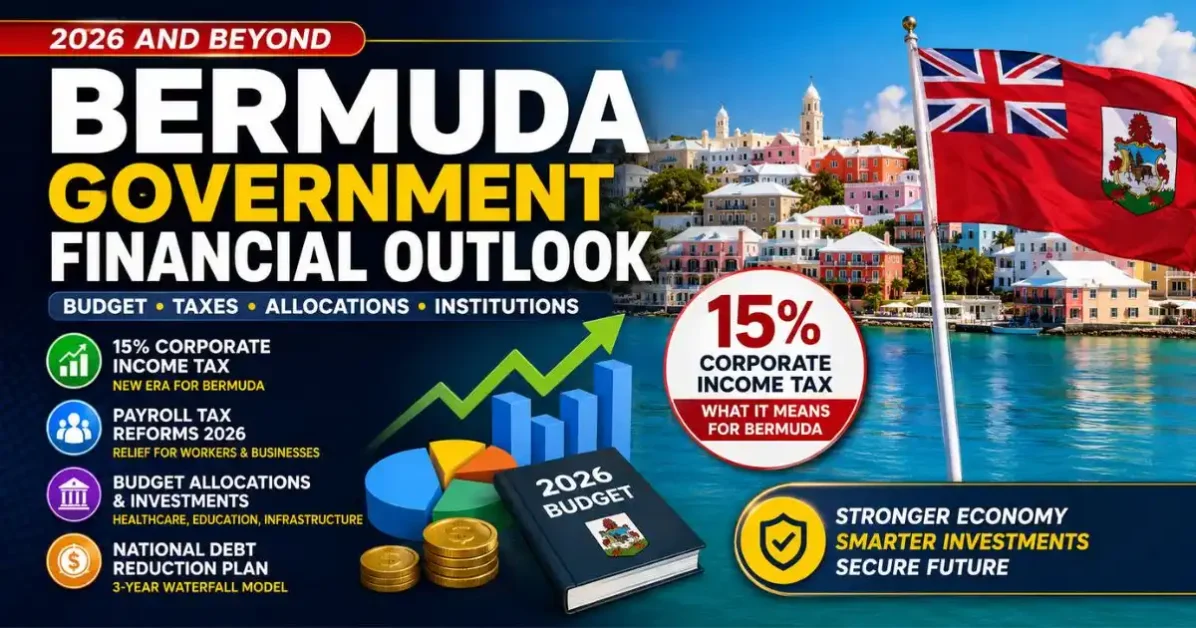
Understanding the Bermuda Government Financial Outlook is increasingly important for multinational corporations, investors, residents, property owners, and financial professionals. The 2026 budget outlines major reforms, including the implementation of the Bermuda corporate income tax 15% for qualifying multinational enterprise groups, payroll tax reductions for workers and businesses, and a structured approach to lowering Bermuda’s national debt. At the same time, institutions such as the Ministry of Finance, the Office of the Tax Commissioner, Government House, and the Land Valuation Department each play distinct roles in maintaining fiscal stability. This guide explains those responsibilities, breaks down the latest tax framework, and explores how Bermuda plans to finance future growth while balancing affordability and economic competitiveness.
Bermuda’s Fiscal Transformation in 2026
Why Bermuda Is Changing Its Tax Model
For many years, Bermuda’s economy relied on payroll taxes, customs duties, land taxes, tourism, and one of the world’s largest international insurance and reinsurance industries. The absence of a broad corporate income tax became one of Bermuda’s defining economic characteristics. However, international tax standards have changed dramatically following the OECD’s Global Minimum Tax initiative. Rather than resisting these global developments, Bermuda chose to implement a 15% Corporate Income Tax for multinational enterprise groups that meet the applicable revenue threshold. This approach enables Bermuda to comply with international standards while preserving its position as a trusted financial center.
The new system does not affect every business operating on the island. Instead, it primarily targets very large multinational enterprises, allowing smaller domestic businesses to continue operating under Bermuda’s existing tax structure. This distinction helps Bermuda remain competitive for entrepreneurs and local companies while ensuring that multinational corporations contribute under internationally accepted rules. As a result, the government’s fiscal base becomes more diversified, reducing reliance on payroll taxes and import duties over time.
Economic Priorities Behind the Budget
The latest budget demonstrates that the Bermuda Government Financial Outlook extends well beyond tax collection. Government officials have emphasized that new revenue should strengthen the country’s long-term financial health while delivering measurable benefits for residents. Key priorities include reducing the cost of living, supporting healthcare, improving transportation infrastructure, investing in education, and accelerating national debt repayment. These priorities reflect a strategy focused on balancing economic growth with fiscal responsibility rather than increasing public spending indiscriminately.
One notable feature of the 2026 budget is the government’s commitment to payroll tax relief. Instead of raising payroll taxes to offset new expenditures, Bermuda reduced several employer and employee payroll tax rates beginning April 2026. Officials describe these changes as part of the largest payroll tax reduction package in recent years, aiming to increase workers’ take-home pay while helping employers expand hiring. Combined with lower duties on selected essential goods and continued infrastructure investment, these measures illustrate a fiscal strategy that seeks to stimulate economic activity without sacrificing financial stability.
The Executive & Institutional Framework: Who Manages Bermuda’s Finances?
Strong financial governance depends on clearly defined institutional responsibilities. One common misconception found across many online articles is that every financial decision comes directly from the Ministry of Finance. In reality, Bermuda’s fiscal management involves several constitutional and administrative bodies that work together under different legal mandates.
Government House (The Governor)
Government House represents the constitutional office of the Governor, who serves as the King’s representative in Bermuda. While the Governor does not prepare the annual budget or administer taxation, the office performs important constitutional functions related to governance, legislative oversight, and the formal approval of legislation. Government House also has specific responsibilities in areas such as defence, internal security, and external affairs under Bermuda’s constitutional framework. From a financial governance perspective, the Governor helps preserve constitutional accountability rather than directing day-to-day fiscal policy. This distinction is often overlooked in many online articles. Understanding these constitutional boundaries provides a clearer picture of how Bermuda maintains institutional stability while allowing elected officials to develop fiscal policy.
Ministry of Finance & Premier’s Office
The Ministry of Finance serves as the primary architect of Bermuda’s fiscal policy. Led by the Premier and Minister of Finance, the ministry prepares the annual Budget Statement, estimates government revenue and expenditure, develops tax legislation, oversees debt management, and establishes long-term economic priorities. The ministry also coordinates with international organizations and financial regulators to ensure Bermuda remains compliant with evolving global standards. According to the 2026 Budget Statement, the Government’s objectives include maintaining budget surpluses, investing strategically in public services, supporting economic growth, and strengthening fiscal resilience through disciplined financial management. These priorities shape every major policy announcement contained within the annual budget documents.
Breakdown of Government Revenue: Key Tax Systems in Bermuda
The Bermuda Government Financial Outlook is built on a diversified revenue system rather than a traditional income tax model. Instead of relying on personal income tax or value-added tax, Bermuda finances public services through payroll taxes, customs duties, land taxes, corporate fees, and — most recently — the Bermuda corporate income tax 15% for qualifying multinational enterprise (MNE) groups. This diversified approach reduces dependence on a single revenue source while helping the Government respond to changing international tax standards. Recent budget reforms also aim to shift part of the tax burden away from workers by reducing payroll tax rates and broadening revenue through multinational taxation.
A major advantage of this system is its flexibility. Payroll taxes continue to provide stable annual revenue, customs duties remain important because Bermuda imports most consumer goods, and land taxes support local government services through a progressive Annual Rental Value (ARV) framework. The addition of corporate income tax creates a new revenue stream without fundamentally changing Bermuda’s attractiveness for domestic entrepreneurs and smaller businesses. Together, these taxes finance healthcare, education, transportation, public safety, debt servicing, and long-term capital investment.
The Paradigm Shift – Bermuda Corporate Income Tax 15%
The most historic development in the Bermuda Government Financial Outlook is the introduction of the Bermuda corporate income tax 15%. For decades, Bermuda was internationally recognized for having no general corporate income tax. However, the OECD Global Minimum Tax initiative fundamentally changed the international tax landscape. Rather than allowing other jurisdictions to collect top-up taxes from multinational companies operating in Bermuda, the Government introduced its own corporate income tax regime applicable primarily to multinational enterprise groups with annual consolidated revenues exceeding €750 million.
This reform is designed to align Bermuda with global tax standards while preserving the island’s competitiveness. Importantly, the tax does not apply to most local businesses or small enterprises. Instead, it targets the largest multinational groups that already operate within an international tax framework. Government officials expect this policy to generate substantial annual revenue, providing additional fiscal capacity to invest in infrastructure, public services, and debt reduction. By collecting these revenues domestically, Bermuda also strengthens its fiscal sovereignty and reduces the likelihood that foreign jurisdictions will impose equivalent top-up taxes on profits earned through Bermuda-based entities.
Table: Corporate Income Tax at a Glance
| Feature | Details |
| Tax Rate | 15% |
| Applies To | Qualifying multinational enterprise (MNE) groups |
| Revenue Threshold | €750 million consolidated annual revenue |
| Effective Purpose | Compliance with OECD Global Minimum Tax |
| Local SMEs Affected? | Generally No |
| Primary Goal | Strengthen government revenue while maintaining competitiveness |
Payroll Tax Structure and Recent Reform Relief
Payroll tax remains one of Bermuda’s largest and most dependable sources of government revenue. Unlike many countries that levy personal income tax, Bermuda imposes payroll tax on employers, with employers permitted in many cases to recover a portion from employees. The applicable rates vary according to employer category, annual payroll, and employee remuneration. The Government approved several payroll tax amendments effective from 1 April 2026, including lower employee rates in the first income bands, targeted employer relief, expanded dividend exemptions, and new incentives for hiring additional workers.
These reforms demonstrate that the Bermuda Government Financial Outlook focuses not only on raising revenue but also on stimulating employment and easing the cost of living. New Hire Relief encourages businesses to expand their workforce by providing employer payroll tax exemptions for qualifying employees. Additional measures benefit Bermudian seniors, caregivers, and lower-income workers, increasing disposable income while supporting labor market participation. Instead of relying on across-the-board tax increases, Bermuda is using targeted incentives to strengthen economic growth alongside fiscal sustainability.
Table: Key 2026 Payroll Tax Highlights
| Reform | Purpose |
| Reduced employee payroll tax in lower income bands | Increase take-home pay |
| New Hire Relief | Encourage employment growth |
| Employer tax relief | Support business expansion |
| Higher dividend exemption | Lower tax burden on qualifying employees |
| Senior citizen provisions | Support older Bermudian workers |
Office of the Tax Commissioner Bermuda
The Office of the Tax Commissioner Bermuda serves as the island’s principal tax administration authority. Although the Ministry of Finance develops tax policy, the Office of the Tax Commissioner is responsible for administering and enforcing the tax system. Its responsibilities include payroll tax collection, land tax administration, corporate services tax, employer registration, compliance monitoring, taxpayer guidance, and the implementation of legislative amendments.
As Bermuda’s tax framework becomes more sophisticated following the introduction of the corporate income tax regime, the Office of the Tax Commissioner plays an increasingly strategic role. Businesses rely on the office for compliance guidance, filing procedures, payment schedules, and interpretation of tax legislation. Digital services and updated guidance have also improved taxpayer access, making compliance more efficient for employers, property owners, and multinational entities. Strong tax administration enhances public confidence while ensuring that government revenues are collected fairly and transparently.
Customs Duties and Consumption Taxes
Because Bermuda imports most of its food, construction materials, fuel, consumer products, and household goods, customs duties remain a cornerstone of public revenue. Import duties influence retail prices throughout the economy, making customs policy closely connected to the overall cost of living. Recent budgets have introduced targeted duty relief on selected essential goods to help reduce inflationary pressure while preserving customs revenue from non-essential imports.
The Government’s approach balances fiscal needs with affordability. Rather than eliminating customs duties entirely, policymakers selectively reduce duties where households are most affected, particularly for essential products. This strategy supports consumers while maintaining an important source of government income. It also complements payroll tax reductions by improving purchasing power without creating unsustainable fiscal deficits.
Land Tax and Annual Rental Value (ARV) Bands
Land tax is another important component of the Bermuda Government Financial Outlook. Unlike market-value property taxes used in many jurisdictions, Bermuda calculates land tax using the Annual Rental Value (ARV) assigned to each property. Higher-value properties fall into progressively higher ARV bands, ensuring that owners of more valuable real estate contribute a larger share toward public finances. The Land Valuation Department is responsible for assessing ARVs, while the Office of the Tax Commissioner administers collection and compliance.
The progressive ARV system supports fairness while generating stable revenue for government operations. Property owners should regularly review updated ARV assessments because changes in valuation may affect future land tax liabilities. The Government periodically reviews the ARV framework to reflect changing property market conditions and broader fiscal objectives. For homeowners, investors, and landlords, understanding these assessments is essential for effective long-term financial planning.
Table: How the ARV System Works
| Component | Description |
| Assessment Basis | Annual Rental Value (ARV) |
| Administered By | Land Valuation Department |
| Collection Authority | Office of the Tax Commissioner |
| Tax Structure | Progressive bands |
| Purpose | Finance public services and local government operations |
Budget Allocations 2026: Where Bermuda Is Investing Public Money
The Bermuda Government Financial Outlook is not only about collecting revenue — it is equally about how those funds are allocated to improve the quality of life for residents while maintaining long-term fiscal sustainability. The 2026 Budget demonstrates a disciplined spending strategy that balances economic growth, public services, infrastructure modernization, and debt reduction. Rather than significantly increasing government expenditure across every department, the Government has prioritized investments that generate measurable economic and social returns. These priorities include strengthening healthcare, supporting education, upgrading transportation networks, expanding digital government services, improving public safety, and reducing the national debt. This balanced approach reflects Bermuda’s objective of maintaining fiscal responsibility while ensuring that taxpayers receive visible benefits from government spending. Official budget documents also emphasize maintaining operating surpluses wherever possible so that future generations inherit stronger public finances rather than higher debt burdens.
Another defining feature of the current fiscal strategy is transparency. The Government publishes detailed budget estimates and expenditure reports that allow citizens, businesses, and investors to understand how public money is spent. This openness strengthens confidence in public institutions and helps international investors evaluate Bermuda’s long-term economic stability. Within the broader Bermuda Government Financial Outlook, spending decisions increasingly focus on investments that enhance productivity, improve resilience, and support sustainable economic development instead of short-term political objectives.
Healthcare and Social Assistance
Healthcare remains one of the largest expenditure categories within Bermuda’s annual budget. The Government continues to support public health programs, including the Health Insurance Plan (HIP), FutureCare, and funding for the Bermuda Hospitals Board (BHB). These programs help ensure that vulnerable residents, seniors, and lower-income families maintain access to essential medical services. Rising healthcare costs, an aging population, and increasing demand for specialized medical care have made healthcare funding a strategic priority in recent budgets.
The Government is also investing in preventive healthcare and digital modernization. Expanding electronic health records, improving community-based care, and strengthening public health infrastructure aim to reduce long-term costs while improving patient outcomes. Preventive care initiatives — including health screenings, chronic disease management, and wellness campaigns — help reduce pressure on hospitals over time. By combining operational funding with targeted reforms, Bermuda seeks to create a more efficient healthcare system that remains financially sustainable.
Key Healthcare Priorities
| Area | Objective |
| HIP & Future Care | Affordable healthcare coverage |
| Bermuda Hospitals Board | Operational funding and modernization |
| Preventive Care | Reduce long-term healthcare costs |
| Digital Health | Improve patient services and efficiency |
Education and Workforce Development
Education is another cornerstone of the Bermuda Government Financial Outlook because long-term economic competitiveness depends on a skilled workforce. Budget allocations support public schools, teacher development, scholarships, vocational education, and partnerships with local and international institutions. These investments are designed to prepare Bermudians for careers in international business, insurance, technology, healthcare, construction, and financial services.
Beyond traditional education, the Government is placing greater emphasis on workforce development. Apprenticeship programs, technical training, digital skills initiatives, and professional certification opportunities help bridge the gap between education and employment. Businesses benefit from a larger pool of qualified workers, while residents gain access to higher-paying career opportunities. This strategy aligns education spending with Bermuda’s broader economic priorities and supports sustainable growth.
Infrastructure Development and Capital Projects
Infrastructure investment plays a central role in maintaining Bermuda’s competitiveness and improving everyday life. Budget allocations include funding for road resurfacing, bridge maintenance, public buildings, water management systems, ferry terminals, bus depots, and digital infrastructure. These projects not only improve public services but also create employment opportunities and stimulate economic activity within the construction sector.
Transportation improvements remain especially important because Bermuda’s economy depends on efficient movement of people and goods. Continued investment in buses, ferries, road maintenance, and public facilities supports tourism, international business, and local commerce. Infrastructure modernization also increases resilience against hurricanes and climate-related risks, ensuring that public assets remain operational during severe weather events.
Major Infrastructure Priorities
| Investment Area | Expected Benefit |
| Road Rehabilitation | Safer transportation |
| Public Transport | Improved reliability |
| Government Buildings | Better public services |
| Digital Infrastructure | Faster government operations |
| Climate Resilience | Protect public assets |
Public Safety and Government Services
Public safety remains essential for maintaining Bermuda’s reputation as a safe jurisdiction for residents, tourists, and international businesses. Budget allocations continue to support the Bermuda Police Service, Bermuda Fire and Rescue Service, customs operations, border security, and emergency management agencies. Investments in technology, training, and equipment improve operational efficiency while strengthening public confidence.
Digital transformation is another major focus. Government departments are expanding online services that allow residents and businesses to submit applications, pay taxes, renew licenses, and access public information electronically. These improvements reduce administrative costs, shorten processing times, and enhance transparency.
Content Gap Special – The Bermuda National Debt Reduction Plan and the Three-Year Waterfall Model
One of the most overlooked aspects of the Bermuda Government Financial Outlook is the Government’s structured approach to reducing public debt. While many articles discuss tax reforms, relatively few explain how new revenue will actually be used. Bermuda’s fiscal strategy introduces a disciplined Bermuda national debt reduction plan, often described as a Three-Year Waterfall Model, under which surplus revenues — particularly those generated by the new corporate income tax — are directed toward debt reduction before being used for significant new spending initiatives. This approach reflects a long-term commitment to restoring fiscal strength rather than allowing temporary revenue increases to create permanent expenditure obligations.
The concept is straightforward but powerful. Instead of immediately expanding government programs whenever additional revenue becomes available, Bermuda intends to prioritize repayment of outstanding debt, strengthen financial reserves, and improve overall fiscal resilience. Lower debt levels reduce future interest costs, improve the country’s credit profile, and provide greater flexibility during economic downturns or natural disasters. Investors generally view this type of fiscal discipline positively because it signals prudent financial management.
Simplified Waterfall Revenue Allocation Model
| Priority | Allocation Purpose |
| 1 | Meet essential government operating expenses |
| 2 | Service existing debt and interest obligations |
| 3 | Accelerate national debt repayment |
| 4 | Build financial reserves and contingency funds |
| 5 | Finance strategic capital investments |
This structured allocation model offers several long-term advantages:
- Lower borrowing costs as debt levels decline.
- Improved investor confidence through consistent fiscal discipline.
- Greater resilience during economic shocks or hurricanes.
- More sustainable funding for healthcare, education, and infrastructure.
- Reduced pressure to increase taxes in the future.
Rather than relying on continuous borrowing, Bermuda aims to create a self-reinforcing cycle in which stronger revenues improve fiscal stability, and stronger fiscal stability supports economic growth. That strategy distinguishes the current Bermuda Government Financial Outlook from earlier periods that focused primarily on balancing annual budgets without an explicit long-term debt reduction framework.
Future Economic Outlook: Opportunities and Challenges
The Bermuda Government Financial Outlook suggests that the island is entering a new phase of fiscal and economic development. By adopting internationally aligned tax policies while preserving its strengths as a global financial center, Bermuda aims to remain competitive in an evolving business environment. The Government expects the combination of prudent budgeting, targeted tax relief, infrastructure investment, and debt reduction to support sustainable long-term growth. At the same time, policymakers recognize that global economic uncertainty, inflation, and geopolitical risks require continuous monitoring. Maintaining fiscal flexibility will be essential if international markets slow or external shocks affect tourism, reinsurance, or international business.
The introduction of the Bermuda corporate income tax 15% also creates opportunities to diversify government revenue. Historically, Bermuda relied heavily on payroll taxes and customs duties. The new corporate tax broadens the revenue base without imposing a general personal income tax. If managed carefully, these additional revenues can strengthen healthcare, education, transportation, and digital government services while reducing the country’s dependence on borrowing. This balanced strategy reflects a long-term vision that combines fiscal responsibility with economic resilience.
Managing the Cost of Living
One of the Government’s biggest priorities is addressing Bermuda’s high cost of living. As an island nation that imports most consumer goods, Bermuda faces higher transportation and import costs than many larger economies. Inflation in global shipping and energy markets directly affects household expenses, making affordability an important policy objective. To help residents, recent budgets include targeted customs duty relief on selected essential goods and payroll tax reductions designed to increase disposable income. These measures work together to ease financial pressure without compromising fiscal sustainability. Continued investment in public transportation, digital government services, and healthcare efficiency may also reduce indirect living costs over time.
H3: Population Aging and Pension Reform
Like many developed economies, Bermuda faces demographic challenges associated with an aging population. A growing proportion of retirees increases demand for healthcare, pensions, and long-term care services while reducing the size of the active workforce. These trends place additional pressure on public finances if left unaddressed. The Government continues to review pension policies, workforce participation initiatives, and healthcare funding models to ensure long-term sustainability. Encouraging workforce development, supporting immigration where appropriate, and improving productivity are expected to remain important elements of Bermuda’s economic strategy. Investments in education and vocational training also help prepare younger generations for careers in high-value sectors such as insurance, fintech, accounting, and digital services.
Maintaining International Competitiveness
Although Bermuda has adopted the Bermuda corporate income tax 15%, it remains one of the world’s leading international financial centers. The island continues to offer political stability, a sophisticated legal system based on English common law, experienced financial professionals, and a respected regulatory framework. These advantages remain attractive to multinational businesses even as global tax rules evolve. The Government’s challenge is maintaining this competitiveness while complying with international standards. Policymakers have emphasized regulatory certainty, transparent legislation, and efficient tax administration through the Office of the Tax Commissioner Bermuda. Combined with continued investment in digital infrastructure and public services, these efforts aim to reinforce Bermuda’s reputation as a trusted jurisdiction for global business.
Strategic Takeaways
Several themes define the Bermuda Government Financial Outlook for 2026 and beyond:
| Strategic Area | Key Insight |
| Tax Reform | Introduction of the Bermuda corporate income tax 15% for qualifying multinational enterprises. |
| Payroll Relief | Lower payroll taxes support workers and employers while encouraging economic growth. |
| Fiscal Discipline | Budget surpluses and responsible spending remain government priorities. |
| Debt Reduction | The Bermuda national debt reduction plan prioritizes paying down debt before expanding spending. |
| Infrastructure | Continued investment strengthens transportation, healthcare, education, and digital services. |
| Global Competitiveness | Bermuda aligns with international tax standards while preserving its financial services leadership. |
FAQs: Bermuda Government Financial Outlook
- What is the Bermuda Government Financial Outlook?
The Bermuda Government Financial Outlook refers to the Government’s fiscal strategy, including budget allocations, tax reforms, public spending priorities, debt management, and long-term economic planning.
- Who must pay the Bermuda corporate income tax 15%?
The Bermuda corporate income tax 15% generally applies to qualifying multinational enterprise groups with annual consolidated revenues exceeding €750 million, in line with international OECD standards.
- What does the Office of the Tax Commissioner Bermuda do?
The Office of the Tax Commissioner Bermuda administers payroll tax, land tax, corporate services tax, employer registration, compliance monitoring, and taxpayer guidance under Bermuda’s tax legislation.
- How are land taxes calculated in Bermuda?
Land taxes are based on Annual Rental Value (ARV) rather than market value. Progressive Land tax ARV bands Bermuda determine the amount payable depending on the assessed rental value of the property.
- What is the Bermuda national debt reduction plan?
The Bermuda national debt reduction plan prioritizes using budget surpluses and additional revenue — particularly from the corporate income tax — to reduce outstanding public debt, strengthen financial reserves, and improve long-term fiscal sustainability.
Conclusion
The Bermuda Government Financial Outlook illustrates how a small island economy can adapt successfully to significant global tax changes while maintaining fiscal discipline and economic competitiveness. The introduction of the Bermuda corporate income tax 15% represents one of the most important policy reforms in Bermuda’s modern history, yet it has been carefully designed to affect primarily large multinational enterprise groups rather than local businesses. At the same time, payroll tax reductions, strategic infrastructure investments, healthcare funding, and education spending demonstrate that the Government is balancing revenue generation with economic growth and public welfare.
Equally important is Bermuda’s commitment to long-term fiscal sustainability. Through the Bermuda national debt reduction plan, disciplined budget management, and the structured Waterfall Revenue Allocation Model, policymakers aim to strengthen public finances while improving essential public services. Institutions such as the Ministry of Finance, the Office of the Tax Commissioner Bermuda, Government House, and the Land Valuation Department each contribute to a governance framework built on accountability and transparency.
For residents, investors, multinational corporations, and property owners, understanding these reforms provides valuable insight into Bermuda’s future direction. As international tax standards continue to evolve, Bermuda appears well positioned to remain a respected global financial center while building a stronger and more resilient economy.